

As I write this, the Ather stock has closed at INR 1470. It is up nearly 17% in two days since the company declared its results. In US dollar terms, the Indian electric scooter manufacturer now has a market cap of 6.1 billion. The euphoria is understandable. Ather is now EBITDA positive. That’s a big deal for a manufacturer that stared at deep red even at the gross margin level not too long back.
The Numbers
Let’s get the numbers out of the way first. Ather’s operating revenue was INR 12,169 million, a near 89% jump from Q1 FY 26 operating revenues of INR 6,445 million. The rise in revenue comes on Ather’s sales growth trajectory. In the quarter gone by, the company registered 90,808 units. A year back, the number was only 44,900 units.

However, the even more impressive stuff is in the bottom line. The gross margins are at 22.4%, slightly lower than what Ather enjoyed during FY26. However, EBITDA margin is positive, at 0.8%, the first quarter when Ather has turned EBITDA+.
There is also a 71% decline in net losses. At just INR 510 million, this company can reach out for net profitability in a quarter or two.
It’s a big deal.
The thing that numbers don’t tell you is that Ather has managed to carve a premium positioning for its products and high loyalty from its customers. Shipping nearly 30,000 scooters every month while sitting at the top of the price charts is no mean feat. In doing so, Ather has also been increasing the average ex-showroom price of its scooters, which now sit about INR 11,000 higher than what they were in Q1 FY26.

It is also a brand that manages to convert 94% of its buyers to take the subscription of the AtherStack Pro software package. That’s a vote of confidence that any brand would die for.
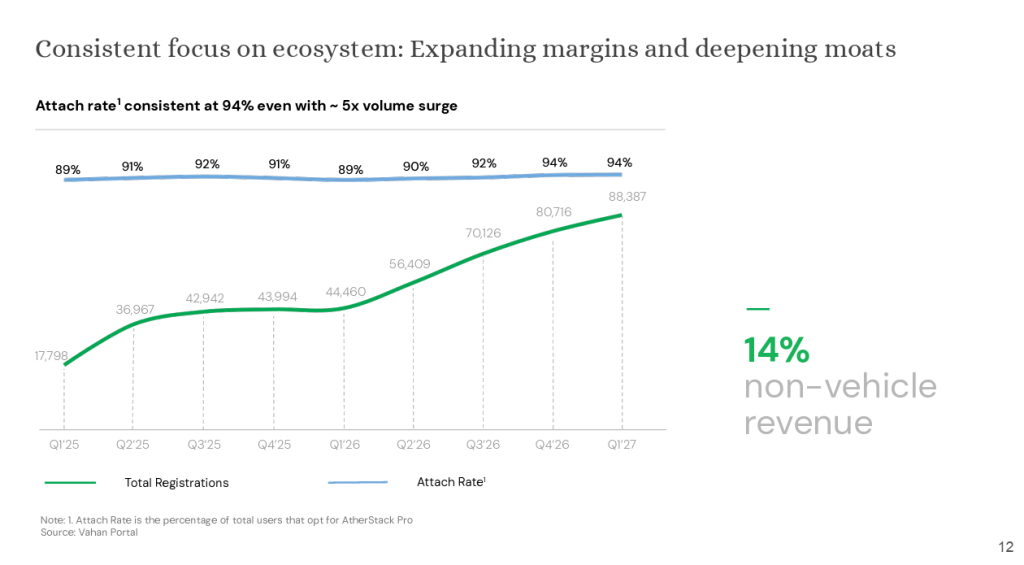
As a result, Ather now has 14% non-vehicle revenue. Obviously, that also counts sales of accessories and merchandise.
Look at the numbers in the overall context, and this seems to be a company that can hardly put a step wrong. The bubbling share price is merely the result of the actions that the company has been taking.
Why then are we trying to find chinks in the Ather armour?
The Indian market is more dynamic than it ever was
As I write this, River Mobility has raised a monstrous 120 million in funding! Last month, River had registrations of 5,964 units. The big raise gives them the breathing space for developing more products and expanding their network. Both companies make very different products. The River Indie is a slightly large scooter that relies more on electromechanical brilliance than on full-fledged software-sensor assist. It doesn’t even have a TFT screen.

However, look deeper, and it is as individualistic a choice as the Ather scooters are, and to some extent both cater to the same audience. Considering that the River guys are as good as engineers as the Ather guys are, they would be snapping at their heels soon.
Then there is VinFast. The Vietnamese e-mobility major is entering the Indian market with a select few scooters from its wide range. On day one, there would be at least three products in the showroom. Considering that VinFast has a very fast development cycle, the polar opposite of Ather Energy, it would be challenging for the Bengaluru-based company to match.
Ather’s market share is dropping
We are doing very well, but the market is doing even better.
That has been Ather’s story in the last five months since March, when the company has been steadily losing market share. Ather’s share of the E2W market has dropped from a high of 18.35% in March to less than 15% in July 2026.
Should we worry about it?
It depends on how you look at things. The very reason why Ather’s profitability has improved significantly is also the reason why the market share has declined. The company is not in a mad race to win market share through discounting.

In the short term, a decline in market share might be a concern. In the long term, a dropping market share is an eventuality no one can escape. There are more entrants heading to the Indian market. Promising startups are raising money. Companies like Honda, Suzuki, and Yamaha will wake up from their slumber, and Hero-Vida has found its groove, somewhat. Whatever Ather does, the market is going to get crowded, and we eventually see the company’s market share settling down at 10-12%. At a million units per month market, somewhere in 2028, that would still be a very juicy monthly number.
Slow is Good; Slow is Bad
Here in Bangalore, on the bustling Bannerghatta Main Road, Ather operates out of multiple floors in a large office park. My guess is they started with a floor or two but have been continually adding more as the company has grown.
I have been fortunate enough to visit them a few times, and they have always been very welcoming and open. The last time was special when InsightEV went in to interview Swapnil Jain, the Ather CTO. I still think it is the best interview on InsightEV and should be the ground zero for any startup learning the ropes today and planning to scale up tomorrow.

 InsightEV – Global Electric Mobility
Swapnil and co-founder Tarun have an unhurried demeanour, a zen-like calm; I think that has come to define Ather’s product development. They’d rather do it right than do it fast, and that is the reason why products go into production when development engineers get bored of tinkering and testing them. Sometimes the development cycles match car manufacturers.
The Rizta, which now accounts for 75% of Ather’s sales, entered some sort of development in 2019. It was launched in 2024. Insiders point out that the EL platform planning started around the same time, or maybe a little later. The EL-01, now named Konarc, is only getting launched in August 2026.
And then there is the motorcycle. The first reference to the Ather Zenith platform was made in Ather’s DRHP in September 2024. At some point in time, the motorcycle project left the Bannerghatta Road building and started taking wings elsewhere. Apparently, it has come back now but is nowhere close to getting to the showrooms. A couple of days back, Tarun Mehta mentioned to trade publication Autocar Pro that the first products on the Zenith platform are still at least two years away. That’s at least four years of development if I count September 2024 as the starting date.
While I am a fan of Slow, and Ather’s spotless reputation is testimony to that, I do feel that Ather is acting more millennial while the world is being outshouted by Gen Z, with Gen Alpha waiting in the wings. Keeping up with the times, especially for the motorcycle’s A-surfaces, for a program four years in development, would be a challenge.
The speed of development is also going to hurt as the industry progresses to the next phase of evolution, where every rival showroom would be crowded with more products and choices.