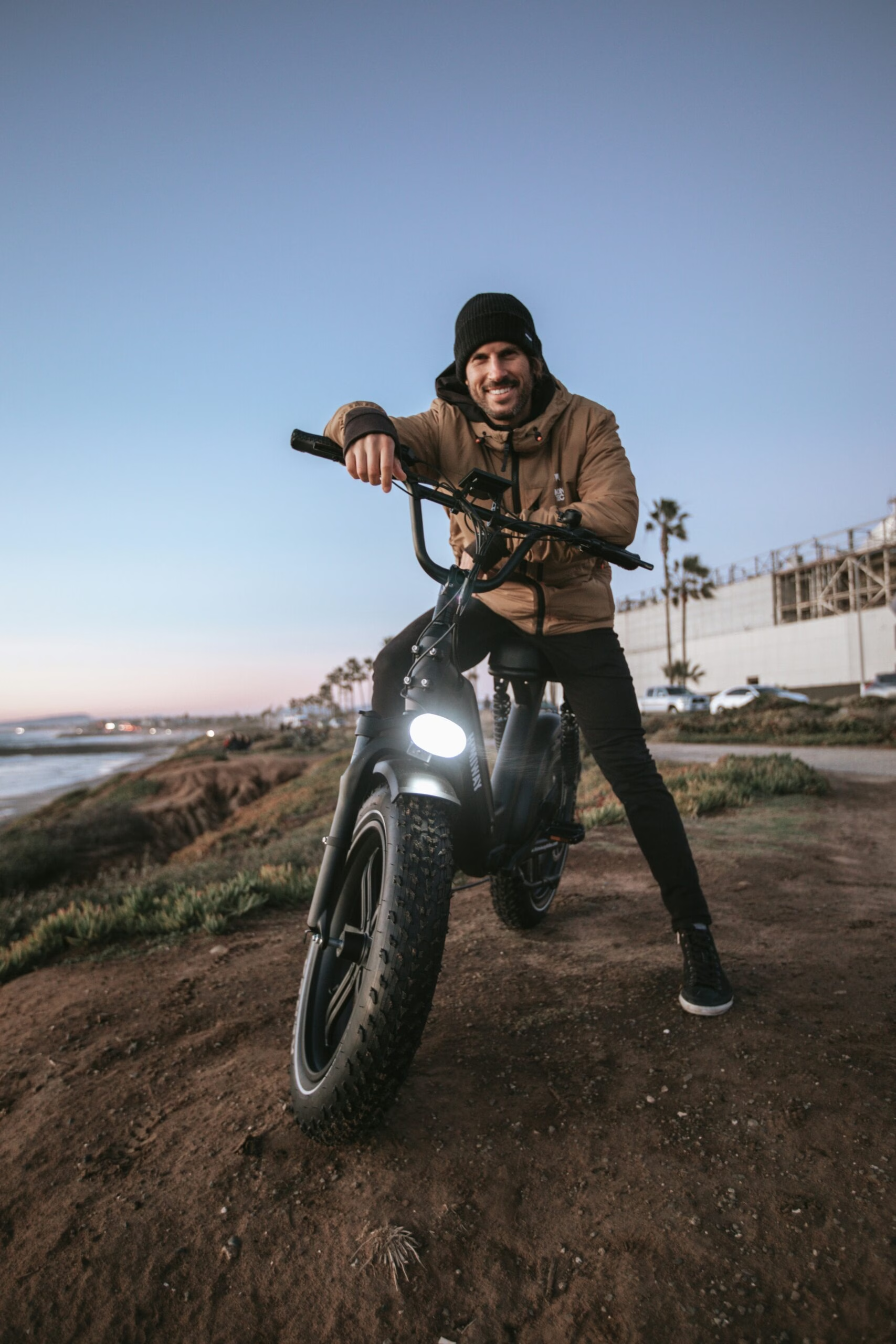
Brazil, a 1.9m two-wheeler market, is at the cusp of going electric in a big way. Last week, we analysed why Brazil could soon be a developing hotspot in electric mobility.
 InsightEV – Global Electric Mobility
While the current two-wheeler market has only a 0.5% share of electric vehicles, electric motorcycles have a huge potential to be deployed in the large delivery market. Highly populated cities like São Paulo and Rio de Janeiro may develop into prime markets if electric vehicle manufacturers price the products competitively.
It helps that the country’s grid is very clean, with a 90% share of renewables.
That may be a challenge now with little or no localisation for electric motorcycles. The ecosystem needs to change. São Paulo-based fund YvY Capital recognises that and is willing to deploy its funds to build the ecosystem.
Deepesh Rathore: Considering Brazil and its flex-fuel strategy, do EVs have any TCO advantage?
Bruno Aranha (Partner and Head of Transition Studio): For mobility, we genuinely believe that we are cost-effective with electric two-wheelers here in Brazil, but to do that, we need to structure the ecosystem. In structuring the ecosystem, we have to have a total cost of ownership less than the ICE, and we have to show that the drivers can gain more than 40% or more in costs by using electric motorcycles because they have access to the motorcycles as a rental through a new business model.
So, when you have this new business model where you don’t have to pay the cost of the motorcycle, the EMIs, the interest, and the gasoline costs, the rider’s capacity for payment increases. They have more money to pay for the rental and improve their quality of life.
We believe that we have the opportunity to change in relation to economic choice, and we also have the chance to improve social and environmental aspects. We also have a lot of accidents here in Brazil because we don’t have the technology to provide more security for these guys.
The idea to achieve net zero and to change the user-base from ICE to electric two-wheelers with a 100,000-motorcycle base to start with, but also eventually change the whole base, is not only for environmental or climate reasons, but also due to economic reasons.
Cassiano Farani (Partner): Yes, there are two drivers, of course. As a continental country, we have big logistics companies like iFood and Didi, and they will change the matrix from ICE to EVs. With electric mobility, you have a good economy for these companies and also for the drivers, and we also have a big environmental opportunity.
Bruno Aranha: At this point, for logistics, we have moto-taxis and Uber, and 99 are the guys here. This market is increasing day by day in Brazil.

Deepesh Rathore: So, currently, what are the motorcycles that are servicing this market? Are these the 150cc motorcycles that are popular in Brazil?
Bruno Aranha: Yeah. People here in Brazil really don’t like to use scooters. They prefer motorcycles, either the city type or trail ones in order to do their services.
Deepesh Rathore: How is the Brazilian electricity supply condition? Are you grid positive? You have ample? Is the grid green?
Bruno Aranha: Brazil is a large producer of oil and gas, but also a huge player in renewable energy. So our energy matrix is very clean, and when you turn to EVs, you certainly are turning to a low-carbon choice. We don’t have this doubt if you think in relation to China, for example, or even India, we have a very clean matrix, and then we are producing more energy than we have the demand here in Brazil.
We are having a situation where you produce the energy, but you don’t have access to the grid to provide the energy to the system. So in this sense, when you structure this new green value chain in Brazil, you are providing a quality demand for this renewable energy.
So in this sense, it’s a very interesting externality of these developments because, in fact, you have renewable energy, but you need to have this demand. When you provide this energy as a service to two-wheelers or four-wheelers, the price is very different from the cost of generating this energy.
Then we have a lot of projects in Brazil in distribution schemes, like different farms close to the cities that produce this energy, and at some point, you can use this capacity to provide the energy for the two wheels.
Deepesh Rathore: The primary target for electric motorcycles is delivery riders. Would it make sense for someone entering this market with swappable batteries to set up a network in the major cities?
Bruno Aranha: Yes, and we truly believe that one city that’s very important in this journey is the city of São Paulo. Of course, because we have a large base of heavy users and also some infrastructure that’s ready to take the swapping and charging systems.
Our first anchor is iFood that’s employing many of these for the heavy users, but of course, we can have different solutions for also the guys that are not heavy users.

Deepesh Rathore: I’m wondering where Brazil stands today in terms of electric mobility? Is there a penetration already of electric two-wheelers, or are you just at the starting point?
Bruno Aranha: In Brazil, we sell 1.8 million motorcycles per year, and the penetration of EVs is 0.5%.
Tom Bandeira (Analyst): About 11,000 electric motorcycles are likely to be sold in 2025.

Bruno Aranha: So it’s not a relevant number and…
Cassiano Farani: Yeah, we’re just starting.
Deepesh Rathore: It’s your starting point really.
Bruno Aranha: But we discuss a lot, as it could be an advantage because we can leapfrog, gaining from the experiences in India, China, and all the Asian emerging economies.
We don’t have three-wheelers as India has. At some point, four-wheelers are more advantageous, and we already have global manufacturers setting up in the country. GWM is setting up a large plant here.
However, the electric two-wheelers are in the early stages, but we truly believe that they can increase very fast. Unlike four-wheelers, which are growing slowly, the two-wheelers are increasing 18% per year. We have a lot of space for two-wheelers in Brazil.
Cassiano Farani: We are at a specific point in Brazil, as we mentioned, and we truly believe that this movement (to E2Ws) will start with the logistics companies because there’s a clear value proposition for that. That’s why we believe that we can be at the point of constructing and operating 600,000 electric motorcycles per year by 2035. The logistics companies and the heavy users will lead electrification. That’s why we believe that’s the test and that we can have exponential growth in the next few years.
Bruno Aranha: I’m thinking while Cassiano is explaining – in this sense, these guys run 150km per day. That’s this sense, as your first question makes sense. It is an economic choice, and this group (delivery riders) is huge here in Brazil, with a lot of influence because they are young entrepreneurs. At this point, when you push them to electric and improve their quality of life, you can mobilize the government because you’re improving the quality of life of these guys.
So, in this sense, to try to articulate to have the regulatory schemes that are necessary, the incentives that India did, that China did, and that we don’t have yet in Brazil. This strategy is to start with these guys is clever because you influence the state government and the municipality to embrace this movement.
Deepesh Rathore: You said 11,000 electric motorcycles were sold last year. Are these mostly imported, or are there any domestic manufacturers in the country?
Bruno Aranha: Mostly imported. We are having a scheme in Brazil where we have a free zone in the Amazon. So what these guys (E2W players) do is that they provide engineering designs or plans to the Chinese manufacturers, and they produce the parts of these models and do the assembly in Brazil in this free zone in Manaus.
But what is essential is not that the electric two-wheelers come from abroad. What’s more important is that the battery, the motor, the electronics, the controllers, and everything come from abroad. You don’t have a vertically integrated company producing all the equipment in Brazil.
Some guys, for example, battery swapping companies such as Vammo, have agreements with players like Vmoto and other manufacturers from whom they import the hardware. Most are imported.
Because of that (lack of local supply chain), Brazilian startups have problems. Take Voltz: they were dependent on the import of the equipment from China, the parts from China, and you need a lot of liquidity for doing that. This causes instability, problems with the suppliers, and they went bankrupt.
So our proposition is trying to solve this problem is to create relevant parts of this industry in Brazil. We know that it’s not possible for now with batteries, but as we have a very large market, we need to have a part of the supply chain here in Brazil. Our fund is focused on the structure of these industries that must exist to have a relevant electric two-wheeler market in Brazil.
Deepesh Rathore: So if I understand it correctly, anyone who plans to now sell electric motorcycles in Brazil in such large numbers should be looking at setting up a local manufacturing plant and Manaus is the ideal location for that. Am I correct in my reading there?
Bruno Aranha: We see some different movements that could be in other states. So, yes, Manaus is the first answer, but you can also think about other states here in Brazil that make sense to install manufacturing. When you make huge investments with different companies, we can have a good competition between the states to receive these investments. But as of now, Manaus would be the first answer.
Cassiano Farani: Deepesh, there’s a plan to bring other states of Brazil to the conversations, because the government takes care of the energy transition, and we saw the possibility of having other plants in other states with some government incentives. So, precisely what Bruno is saying is that there’s a proven place here that’s Manaus, but we are trying to discuss with other governments. We have 25 states in Brazil. So there are some states that we can show the project and have some good conversations about the energy transitions, and in this sense, we saw the possibility to have companies in other states that, for a continental country like Brazil, it’s the best choice.
Bruno Aranha: Yeah, because we have a huge demand in São Paulo, a huge industrial complex in the south of Brazil could make sense. For example, VW is based in the south. At this point, we are in the beginning, and the incumbents, the large companies that dominate the market nowadays, invested a lot in Manaus, so it makes sense for them to stay there. The other guys who are coming to Brazil can try to figure out different schemes.
Deepesh Rathore: Got it. So, I understand that the ecosystem for electric mobility is just taking off in Brazil, and we are in the very early stages, but you have very aggressive plans to sell 600,000 electric motorcycles per year by 2033. Apart from the delivery riders and commercial usage, do you see a great acceptance for electric motorcycles among general customers?
Bruno Aranha: We’re proposing a new structure, an ecosystem for the electric motorcycle players. We have this view to have a large number of electric two-wheelers in Brazil in ten years, but that would only be 20% of the market, while 80% will stay ICE.
When you see the projections of the International Energy Agency (IEA), you find them conservative. We believe that things are changing very fast. We are trying to speed up the process. We aim to create the capacity to do so.
Our intention is to have all the capacity, the technology, the business environment, the governing environment, the communication environment, the commercial contracts, and all the ecosystem ready to do so right. We can’t imagine how the market would grow in the future, but our intention is to have the capacity to do so.
Right now, it’s very complicated for a new guy to come to Brazil and structure everything, and so people delay the decisions. In a broader view, it’s not only electromobility, we are very well positioned to receive foreign investments from companies from India, from China, etc. in order for them to be relevant in our market.
Brazil could be a point to provide the products and services not only to local requirements but also to the whole of Latin America. It makes sense to have a pool here, a kind of hub that will provide solutions for the large Brazilian market, but also for Colombia, for Argentina, and Chile, etc. Why not Africa? So it could be like this new hub for foreign investments.
Deepesh Rathore: That’s inspiring to hear.
Bruno Aranha: Deepesh, just two more things. First, we truly believe that carbon knowledge is very important in this sense because carbon credits are a new source of revenue that is very important and could be divided between the entire value chain. So, when you change ICE to electric two-wheelers, then you have carbon credits, and these could be subsidized.
Second, for the energy companies here in Brazil, they could provide this energy for the new market that we are constructing for them. So they have an indirect interest in having this new market. We are providing a solution that will give them a financial and strategic return.
About YvY as a fund – Investment Philosophy and Process
What is YvY’s investment philosophy (when it comes to mobility/EV tech)?
YvY is an ecosystem fully dedicated to the green economy transition agenda. We invest where Brazil helps the world to decarbonize – energy transition, carbon and food security, and green infrastructure. We have three business units as strategic fronts to a sustainable future: asset management, transition venture studio, and carbon platform.
YvY Capital embraces a pragmatic approach to green transition investments, driving measurable environmental impact while maximizing returns. We focus on Profitable Investments with additional value creation through green transition principles, driving positive environmental and social impact.
YvY Capital embraced a decarbonization philosophy in which:
(i) There is no silver bullet to decarbonization,
(ii) The way forward should be practical and direct, with no overly idealistic net-zero commitment; and (iii) Scalable opportunities that align with economic and environmental goals should be the ones prioritized.
When we analyze the energy transition landscape, we identify that there are no assets and companies ready to receive an investment from our asset management unit. To invest in themes as hydrogen, methanol, ammonia, sustainable aviation fuel, renewable gas, data centers, and electromobility, we need to take a step back and work to develop and structure, in a coordinated way, a group of new projects and business to enable investments for the formation of these new green value chains in Brazil.
There are structural bottlenecks that must be addressed in order to achieve scalable impact: Coordination of large companies and startups in the national and international value chain, Adoption of emerging technologies and innovation, Projects with minimal scale to attract capital, Derisking of projects with risk and capital sharing from their inception, Filling gaps in regulation and legislation, Complex Stakeholder Management.
Considering these challenges, we launched an innovation platform called YvY Climate Venture Studio, alongside an innovative investment vehicle, the FIP YvY Business Factory. Our objective is to move one step upstream, raising and deploying capital to help structure and integrate the value chains that underpin the green transition.
The FIP YvY Business Factory Fund, in an innovative way, will accelerate the development of electromobility in Brazil, supporting the structuring of industrial plant projects and the development of startups, contributing to the formation of a large Electromobility ecosystem in Brazil.
The fund will have, in its E2Ws Class (two-wheeled electric vehicles), corporate and financial investors interested in developing projects in different links of this new green value chain, such as manufacturers of batteries, engines, motorcycles, recharging infrastructure, generators, and energy marketers, delivery and mobility companies, banks, among others. iFood became the first anchor investor, contributing US$7.5 million, out of a total of US$50 million initially in the category. The fund will structure projects up to the FID (Final Investment Decision) and will invest in startups that, together, will form a platform with a potential capacity of up to US$1 billion in new investments in Brazil. The expectation is that by 2035, the Brazilian market will be capable of producing and marketing 600,000 electric motorcycles per year, with affordable and competitive prices, benefiting delivery drivers and other industry partners, in addition to contributing to the evolution of urban mobility.
How big is the typical investment size?
With US$50 million in first committed capital, our fund is structured to deploy across a diversified portfolio. The ticket size will vary in the range of US$10-20 million, depending on the impact of the project on the E2W value chain – to develop new projects (until FID) or invest in startups.
Do you look only at Brazil, or are you also open to more global players as long as they deploy in Brazil?
Our focus is on the development of the E2W market in Brazil. If international players are looking to enter the Brazilian market, we are absolutely open to engaging with them. We believe we offer a strategic platform for global entrants.
We also believe that this new Brazilian green platform, robust and duly structured, could support the electrification of the whole Latin America 2Ws market, providing the products, services, and technology. The recent geopolitical movements reinforce the nearshoring.
We led the Brazilian National Development Bank (BNDES) for four years, which gave us deep clarity on how to structure and accelerate value chains. This experience reinforced our belief that a chain-development model is essential to unlock the full potential of the E2W ecosystem.
We also believe that leveraging investment funds as vehicles to structure energy transition projects is a globally relevant strategy. While each market has its own nuances, the core challenges – scaling technology, mobilizing capital, aligning incentives, and integrating fragmented value chains – are extremely important across geographies.
What should an EV-tech startup do to get on your radar?
We are looking for partners of choice. Startups and entrepreneurs that are looking for more than capital. Having a capable team, a strong culture, a solid project, and a long-term vision are essential for standing out. In addition, we look for founders with a country-building mindset, an ecosystem perspective, and a long-term view of relationships. Those who understand that scaling impact in Brazil requires aligning financial returns with environmental outcomes. Startups should offer a product or solution that fits strategically within a specific link of the two-wheeler electromobility value chain.
What is the most important factor for you when you consider investing?
We consider economic soundness, environmental impacts, and innovation components. This integration of the strategies in order to unlock opportunities across diverse value chains.
We focus on solid business models with proven scalability, prioritizing investments with low commercial risk that drive multiple growth levers, backed by effective governance with a proven environmental impact, and an innovative approach.
How long does the entire process take at YvY—from first contact to funds transfer?
We follow a rigorous and multi-faceted analysis process to ensure that the company follows our guidelines of environmental innovation and has a robust business model. It depends on the specific opportunity.
Does YvY invest at the idea stage, or do you wait for some traction in the business?
No, we do not invest in idea-stage ventures in the way that traditional venture capital typically does. As mentioned earlier, our focus is on intellectual property that serves as the foundation for structuring the electric motorcycle value chain. These are strategic assets that enable the development of scalable and systemic solutions.
Our second investment vertical targets later-stage startups -typically Series B – that are already operating within and adding value to this same ecosystem. The goal is to catalyze both the upstream structuring of the market and the scaling of proven business models across the E2W value chain
How do you evaluate a team? What are you looking for?
We look for teams that are engaged, have deep expertise in the sector, and are grounded. We see many ambitious projects globally that are often not feasible or sustainable. We will assess teams based on their track record, background, growth mentality, and their proven understanding of the sector.
Is a technology edge better than management quality?
Both are essential, just as technology and management are equally critical. What good is having a top-tier team if there’s no applicable technology behind the business? Even the most advanced and innovative solutions will fall short without a capable team to execute and scale them.
Is Brazil at the cusp of a revolution in electric mobility?
Do you see a mass movement to E2Ws from ICE? Absolutely. Brazil has everything it takes to lead the West in E2W adoption. The country has a deeply rooted two-wheeler culture – it holds the largest 2W fleet in the West and the fifth largest in the world. In 2022, for the first time in 30 years, motorcycle sales outpaced car sales. While E2Ws still represent a small fraction of those sales, we believe Brazil has all the conditions to shift that reality: affordable and renewable energy, access to critical minerals for battery production, and a consumer base actively seeking lower-cost alternatives – driven largely by heavy users such as delivery riders and motorcycle taxis. Our goal as a fund is to create the conditions for Brazil to produce 600,000 E2Ws annually by 2033, capturing 20% of the national 2W market share.
Investors in the fund managed by YvY Capital, like iFood, can have shared strategic and financial returns. Strategic returns include accelerating the execution of their new business planning, expanding the offer of current and new products and services, promoting the decarbonization of their activities, accessing and purchasing new assets and businesses, and generating integrated innovation with other ecosystem players. Financial return involves the reimbursement of their investments through the sale of structured projects (FID) and invested startups.
InsightEV – Global Electric Mobility
InsightEV – Global Electric Mobility
InsightEV – Global Electric Mobility