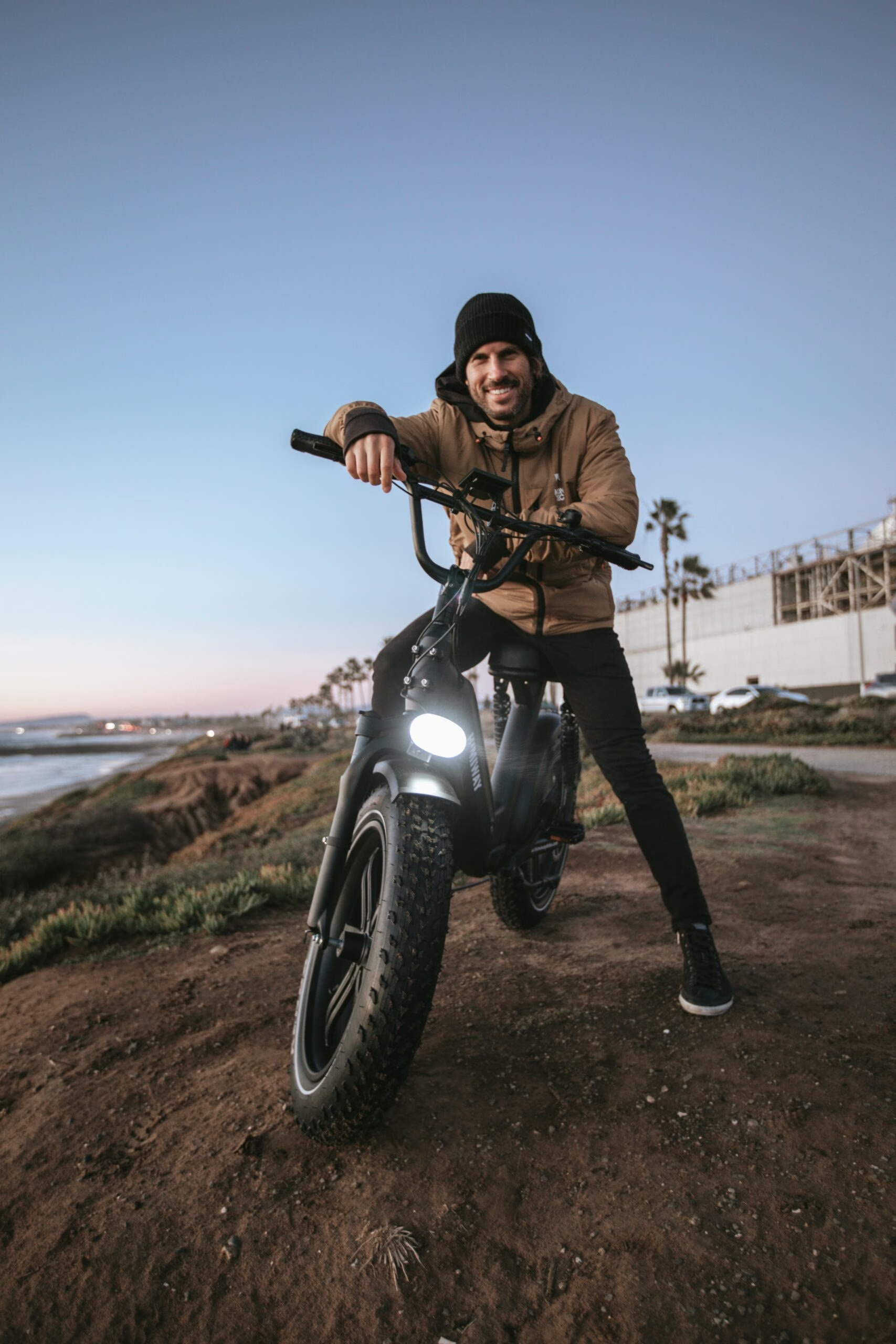
Zeno Moto has recently launched the Emara in the African market. The Emara is one of the very few motorcycles in Africa that has been designed ground up for the continent. With the first batch of Emaras delivered to the customers, we found this a good time to learn from Michael Spencer’s early experience in Africa, the Kenyan market in particular.
Michael, thank you for taking the time out. I know you have launched Emara in the Kenyan market recently, and we wanted to chat with you about the strength of the market. Recent data that we looked at indicates that electric penetration has jumped in the market. However, the market itself has collapsed. Why do you think that has happened?
Also, what is your local experience there, and what has really led to the market collapse? I know the Kenyan Shilling has been extremely volatile, but is that the only reason for the collapse of the market?
Michael Spencer: Good question and a good topic. We’ve explored this a lot and researched it quite a bit as an industry as well. We have a perspective on what’s been driving the reduced growth and the plummeting petrol two-wheeler sales over the last couple of years.
If you go back to the rise of petrol motorbikes in Africa, it started about 15 years ago, in the early 2000s. Before 2008, you had some Yamaha and Honda 250/300cc dirt farm bikes. Very small quantities, maybe just a couple thousand sales a year.
Yes. I think most were imported in a used condition.
Michael Spencer: But, around that time (2007-2008), the idea of much more affordable 100cc, 125cc, and 150 cc standard commuter bikes being imported was conceived as an opportunity for youth job creation for taxi work.
So there were some good incentives put in place in that era to make it more affordable to import without the duties and tariffs that had been in place. You saw a very rapid explosion of two-wheeler imports and sales from 2010 up to 2022.
The first wave was Chinese bikes; very cheap Chinese motorcycles. Those were pretty quickly, for the most part, pushed out of the market by higher quality Indian motorcycles – TVS and Bajaj that now represent 70% market share, and now Chinese products account for less than 15-25% of the market, primarily only in the rural areas.
The lion’s share of imports here is for commercial use, for motorbike taxis. It’s about 90% motorbike taxis, 10% are delivery riders, but they do both. You’ll have an informal ( i.e., not using a ride hailing app) taxi guy who will drop somebody’s kids off at school in the morning and pick up their groceries at the market an and drop them off, and then go get the kids while also using the bike for his daily life needs or traveling to visit family on the weekend, etc.. So, use here is really a mix and matching of personal use, delivery work, taxi use, and running errands.
With this in mind, the driving force that brought a wave of motorbikes into the country in the early 2000s was very much driven by economic benefit; motorbikes were both an empowering tool for personal mobility but also economic mobility.
Kenyans love the flexibility of boda boda bike taxis, with estimates that upwards of 30% of the country use one on at least a weekly basis. Demand for boda boda rides outstripped supply, and over a decade, there was continued growth of the boda boda (taxi) sector with successive waves of more and more people buying these motorcycles. You’d have a common case where an auntie/ uncle would cover the down payment on a motorbike for somebody when they graduated from secondary school to give them a head start on a job as a boda driver, etc.
Eventually, a couple of things happened. As a public transportation tool, these motorcycle taxis started to reach something close to saturation levels across the country, with 1.5-2.0 million Boda drivers operating across the country, providing flexible daily taxi transport for a country of 55 million people.
Wow! That’s a lot of commercial motorcycles.
Michael Spencer: You can go to rural parts of the country where you come to an intersection like a relatively remote intersection, maybe with two or three shops, and you’ll have 60-70 boda drivers parked there. So even in a relatively unpopulated part of the country, you might have that many people trying to make their living as a boda driver.
That’s fairly large and unsustainable.
Michael Spencer: So, oversaturation: when one person walks up to get a ride and they’ve got 60-70 boda guys, all offering to give them a ride. That’s a bit oversaturated. So one factor for the collapse in sales was the natural meeting of a supply and demand equilibrium, where it didn’t make a lot of sense for a new 18-year-old coming out of school to buy a motorbike and be a boda driver.
They’re a relatively collectivist mindset group of gig workers, which is interesting to watch.
In what way?
Michael Spencer: So, when you have a customer walk up to a stage with 60 boda drivers saying, I need a ride from here to somewhere, you don’t get people saying I’ll do it for five shillings less, or I’ll do it for six shillings less. Or, I will do it for half of that. You don’t get that auction kind of behavior. You just get a general consensus that the ride from here to there would cost this much, and we’re all gonna charge the same, whoever you want to take. Then they will share rides around. So you don’t see people trying to outbid each other in a way that you might expect.
That’s one big factor in creating equilibrium between the supply and the demand that boda riders have reached.
The other big factor that compounded it is the rising cost of fuel in the market.

Has that been very volatile?
Michael Spencer: Through 2020, to the end of 2022, and then most of 2023, and 2024, we had several big fuel price spikes that made the daily economics of being a boda driver much worse
So, combined, you get a situation where everybody is seeing less revenue and much higher fuel costs (input costs), resulting in making much less. The business was being spread across more drivers. Then the cost to service that smaller number of customers on average a day went up with higher fuel costs.
That sounds like the perfect storm.
Michael Spencer: To add to that, the shilling (KES) weakened, making the purchase price of the motorcycle more expensive, which, combined with the much less interesting economics, and it wasn’t as exciting to be a boda driver, a new boda driver that is. It wasn’t as interesting to enter the market as a new boda driver. So those are a couple of compounding factors.
The third compounding factor is that motorbikes here generally operate with around a 5-6 year lifespan. We saw a huge amount of growth in 2020-23. During that time, the market was growing at like 30-40% rate per year. That was also a function of several companies offering more accessible motorbike financing than ever before. Generally, you would have to come up with cash to buy a motorcycle. There was no way banks would offer loans. There weren’t a lot of third-party financers. Then several companies came into the market and, at very exorbitant, very high rates, started lending to boda operators, which allowed a lot more people to buy motorcycles than would have been able to afford them previously. So you had this massive expansion of the motorcycle market in this period because more people could afford them with the financing.
That all kind of came to a head in late 2023, and continues till today, where we have hit this equilibrium point.
Fuel got more expensive, and there are a lot of motorcycles that are less than 3-4 years old in the market. If you did a survey of 100 motorcycles in Kenya, in Nairobi, in mid-2023, the vast majority of them would have an average age of like 2-2.5 years.
So the general consensus is that we’re still dealing with this equilibrium of kind of there’s enough motorbikes right now to serve the population until the population grows, and that we don’t need many more boda drivers in the country. We have a lot of motorcycles that were purchased in that 2020-23 period and are going to be reaching their end of life in the next one to three years.
So there is an expectation, and when you talk to lenders here, talk to the dealers here, and the customers, there is an expectation that this year we are already seeing improved growth over last year, and the next year is going to see even increased motorcycle sales because motorcycles are starting to reach their end of life and get replaced. The average lifespan is 4-6 years because these motorcycles are commercial purposes and average 35-40,000 km a year. So in 5 years they’re doing 200,000 km +, which is a lot for a 150 cc motorbike.

Agree. That’s beyond the lifetime of any 150cc ICE motorcycle that gets subjected to rough use every day.
Michael Spencer: So, those are the primary factors that we have assessed as the cause for the big slump in sales. Everything is exacerbated by the skyrocketing fuel prices through 2023, where it didn’t make sense to be doing this (boda) as a living anymore. These are the primary factors that have driven the drop in petrol motorcycle sales.
So, what you are implying is that you will see a strong bounce back in a couple of years, due to the cyclical nature of the market, and it is likely that a large share of that bounce back would go towards electric motorcycles. Am I right in assuming that?
Michael Spencer: Yeah, you stole my (and the data’s) punch line, which is what we saw last year, 2023-24, is that we went from electric motorcycles being 3% of new sales, on a very small base, to 7% last year.
That’s massive. That’s a 250% CAGR, and we are on track for that to then grow more, and we’re playing a part in it by ramping our sales.
All of our demand signals right now suggest that we have more demand right now, with customers waiting to take delivery of our product (Zeno Emara) or pay deposits, than all petrol motorcycle sales last year in Kenya.
That’s incredible. This looks very promising for e-Motorbikes.
Michael Spencer: What’s exciting about the East African market, and Kenya within this context, is that the economics of the cost of fuel and the commercial operation of this asset is such a big factor in deciding to buy a motorbike. When the right EVs have shown up, and when you get a really good high-quality product, like what we are delivering to customers, that is a 150 cc equivalent, 250-300 kg payload carrying capacity, really comfortable to ride, motorcycle, customers are willing.
The customers are now saying that I want that and the number pencil for me. I can make money buying and owning and and running this as a boda taxi.
I referenced earlier that there’s kind of this collective approach to not charging customers different prices with petrol boda drivers, but what we’ve seen over the last two years, and there was some academic research that just came out on the same, is that the market-clearing price for a motorbike taxi ride in Kenya has come down. As more electric motorcycles are on the road, the cost to operate a motorbike taxi has come down by about 50%. So we’re actually seeing kind of average prices for a ride in Kenya drop by 5-6% because the cost to operate is dropping now.
So if petrol prices are going up and the ride prices are coming down, that means the boda operator is getting squeezed from both sides? And that would be a greater incentive to move to electric?
Michael Spencer: Well, ride prices generally stay consistent and increase a little bit with inflation. Where we have seen ride prices really come down (there have been studies) in a place like Kigali, Rwanda, which has banned the import of petrol two-wheelers, so many drivers are faced with better EV economics and can afford to drop their prices slightly in urban settings where collective behavior is not as prevalent.
Yeah.
Michael Spencer: That city is primarily electric two-wheelers. In Kigali, the price of a motorbike taxi ride has gone down because 5/10, when you get a motorbike taxi ride in Kigali, it’s on an electric motorcycle, and that driver has lower costs to deliver that ride for you.
I would say that the Kenya market would be very interesting for the next 2-3 years as we come out of this temporary recession in motorcycle sales, and most of the boom would likely go towards electric motorcycles.
Michael Spencer: Yes. I’d say not just for Kenya, but the larger East African market. Ethiopia has also already banned the import of petrol two-wheelers. So Ethiopia and Rwanda have both banned.
Tanzania, Kenya, and Uganda have similar economies for boda drivers. Collectively, 5-6 million boda drivers operate and have similar costs to operate, same fuel prices. The fuel prices in Uganda are slightly higher because logistics are more expensive. It is further inland for imported fuel.
So, today and over the next 2.5-5.0 years, we are seeing thousands of petrol two-wheelers reach their end of life or are sold at 2-3 years of age into very rural markets or neighboring markets like South Sudan, etc. Then the majority of the fleet is going to be replaced. Over the next five years, around 1.5 million motorbikes will need to be replaced on the road, as the existing fleet reaches its end of life, and demand grows.
So, 1.5-2.0 million motorbikes will need to be replaced or added to the fleet in the next five years and it’s expected, from everything we’ve seen and everything that the industry has seen, that the vast majority of those will be electric.
How is the Zeno rollout going out in the African markets?
Michael Spencer: It’s going very well. We’ve developed an excellent product. Consumers love it. It is more than half the cost (TCO basis) of a petrol motorbike. It’s around 15-20% more affordable to operate than any of the other electric motorcycles here. It is one of the most affordable electric motorbikes to buy and it brings a smile to the face of anybody who drives it, which is pretty awesome.
So, we are rolling out 5-10 new charge point locations every week. We are demonstrating economics that have a very strong, very early (a rare combo) margin profile, and that’s pretty unprecedented for the industry at the stage of growth that we’re at as a company.
We’re excited to be in these markets with an excellent product that consumers love. In the next five years ahead of us, there’s going to be 1.5-2.0 million electric motorbikes sold in Kenya alone. So it’s it’s going very well and we’re growing our team, expanding production capacity, rolling out charging infrastructure, and have enough demand to keep us very busy.
We have a wait list and a pre-order list that’s over 30,000 strong now, and we’ve actually not started our marketing, advertising, or paid sales efforts yet. We are still effectively in the soft-launch stage, so just several small shops are open. And we have a wait-list of customers that uh is probably one of the strongest on the planet.
I recall that the Emara has both swappable batteries as well as a fast charging option. In your initial rollout, are you focusing more on setting up the swapping network or the charging points?
Michael Spencer: We are very intentionally rolling out both. A lot of the IP that we developed, the patents that we have, are systems that allow a bike to very seamlessly go back and forth between fast charging, swapping, and home charging, all while accessing batteries on a pay-as-you-go BaaS model with a very easy-to-use ( think telecom app style data purchases) platform. It has resulted in a delightful customer experience. So, if I’m going to get on my bike tomorrow and do a 280 km road trip on my Emara, it is only possible because we have a swap station at the edge of Nairobi, and then in two intermediate towns, we have fast chargers. So, I will swap on my way out of town. I’ll stop and fast charge later and have a cup of chai for about 30 minutes, and we’ll finish up my trip with another swap. That kind of user experience of being able to do a 280 km road trip on an electric motorcycle, able to fast charge and swap along the way with battery use and energy purchase as easy as topping up data on my phone is an amazing customer experience that people love and an amazing business model for us because to serve those customers it’s quite affordable with the combination of our three charging solutions.

We see our customers, on average, do around a quarter of their charging on fast chargers or home chargers and 2-3 quarters of their charging through swaps. However, it varies by town, the customer, their day-to-day lives, etc. So we have some customers who do all their charging as fast charging, others who do nothing but swapping for the day. But generally, our average is about 25-30% fast charging and 70-75% swapping.