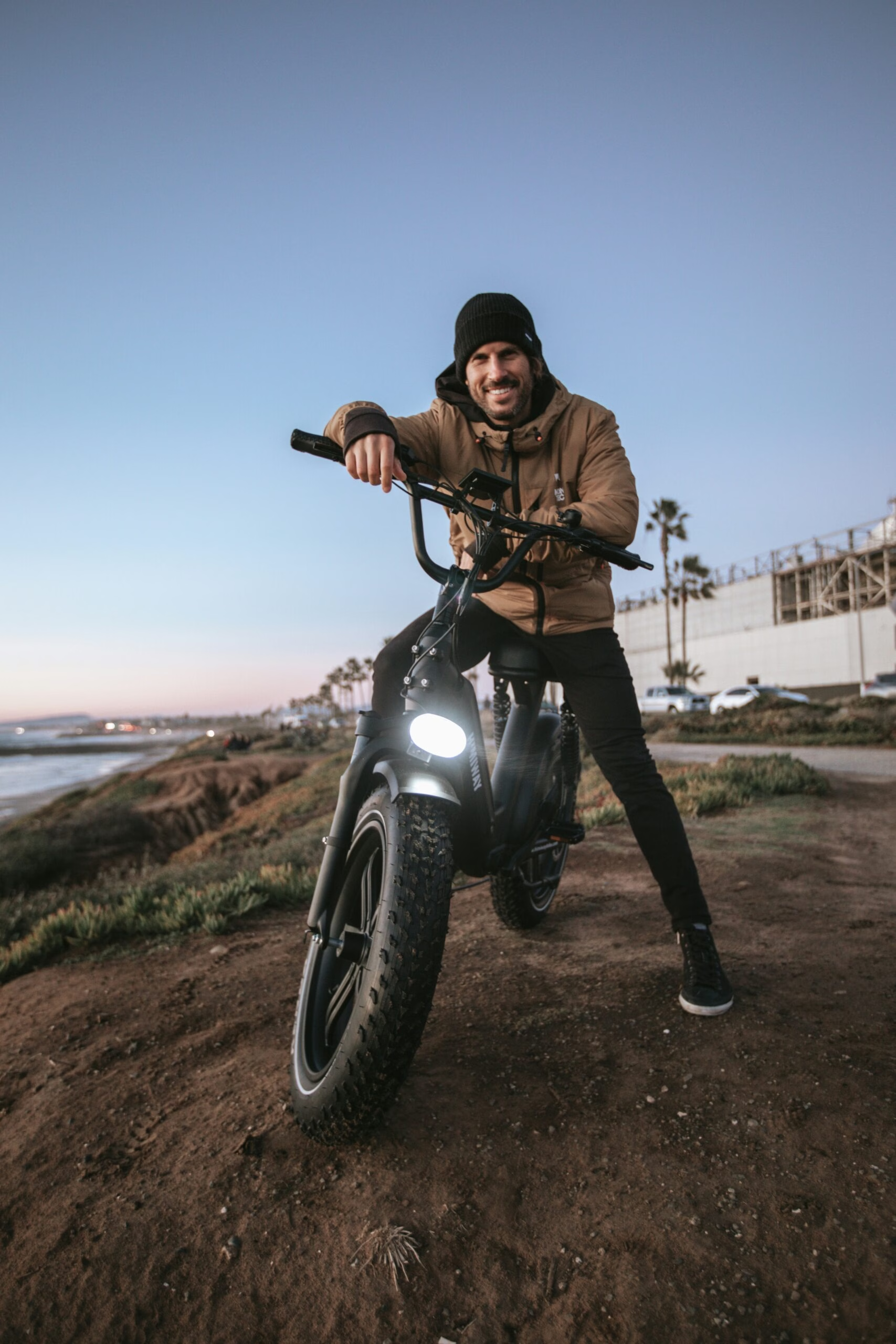
Roam is one of the earliest startups in the African e-mobility landscape. What sets them apart is a motorcycle that has been largely custom-developed for the market, and a business model that sells the motorcycle and (first) battery to the rider/operator. This keeps the company’s CAPEX light and allows for more efficient deployment. As we continue our series on Africa, we caught up with Filip Lövström, the CEO and founder of Roam.
We wanted to start with the history of Roam. I think you are one of the oldest players in Africa? So where did this start? When did you start, and what was the purpose behind the whole thing?
Filip Lövström: Well, the purpose was really to accelerate electric mobility for the region. We saw an increased development towards electric mobility across the world. We saw an increased need for electric all across the world. I’ve spent quite some time in Africa in different parts of my life. I was working in electric mobility in general, and I said, if we want to really develop this sector for Africa, we need to start now. We need to ensure that we build something in Africa, for Africa, specifically in Kenya, that is suitable for the local market.
I mean, for many years, electric motorcycles have been designed in China for Chinese markets or in India for Indian markets, and then sort of come to Africa as a last market. We fundamentally believe that the market is big enough to have bespoke products designed for it. There’s enough of a unique use case in terms of the distance that drivers drive daily, the heavy loads, the commercial utilization, etc., because 95% of the motorcycles here are used commercially, whereas in other places, it is more of a private consumer market space.
So, with a fundamental belief that Africa needs something bespoke, the majority of our team are extremely talented Kenyan engineers. The technology is ripe. It just needs to be packaged in the right product and in the right business model. We set out and started Roam in 2018, and we’ve been at it ever since. We started developing motorcycles in 2020. We spent two years in product development, and then in 2023, we launched our Roam Air.
I think that’s quite a story. 2018 means you’ve been at it for seven years now, nearly eight.
I think Ampersand may have started a little earlier than you, but you would be the second entrant in the African market?
Filip Lövström: Yeah, something like that. When we arrived in Kenya, there were 17 electric vehicles in total in the country. We build much more than that daily now. So it’s quite a different shape the market has taken.

Absolutely. I understand that even with all the action happening right now in Kenya, in Rwanda, and many other countries, I find this as the starting point for African e-mobility. I think we have a long way to travel, and there is a huge market potential. Where is Roam in the journey now? How many motorcycles have you deployed, and what is your annual rate looking like now?
Filip Lövström: Yeah, we have deployed about 4,000 motorcycles over the past two and a half years. Right now, we’re growing at about 3X annually. So it’s quite an exciting time. We’re doing in the range of 300-400 motorcycles per month. But that is not constrained by the market. It’s rather the opposite. In the market, the demand is insane. The demand is super high from the consumer side. What we are focused on right now is to increase our output of products, which is primarily constrained by developing our suppliers and making sure that they can deploy all the components that we need and make sure that we get them here in time. I mean, we have undertaken the slightly longer journey of designing both our products (motorcycle and battery) from the ground up.
So we have a lot of engineering and IPs behind it, and it has given us the desired results because we’re now able to do a cost reduction as we work with suppliers across the world, and in Kenya. We have acute ownership of each component.
Your assembly is happening in Kenya. Coming to that, considering that we are at what we call taking the first steps in African electric mobility, the assembly and manufacturing in Africa, I’m sure it’s a rewarding process, and there’s a lot of learning, but do you face any challenges? Is there anything that you would like to tackle there?
Filip Lövström: I think asking entrepreneurs and founders in general about challenges? I view it as something that goes on the to-do list, right? There are a bunch of things that we have to do over the coming couple of years to reach the planned scales. We are committed to reaching an output capacity of 150,000 motorcycles per year from this factory, and then we want to grow and scale the continent. But we are committed to scale.
We’ve designed everything for scale. We’re doing a lot of work with local partners to increase their capacity and make sure that they can supply us with the products that we need. That is a journey. We are localizing more and more components, but we think it’s extremely valuable to have the manufacturing and assembly happening here. If you look at the automotive industry globally, Volkswagen built a country like Germany, and provided so many secondary jobs there. Toyota provided a huge economic boost for Japan. We are positioning Roam to create the same thing here. Create a thriving manufacturing ecosystem because all the competence that we need is here. We just need to work closely with them to increase their capabilities. That’s work that we’ve been doing over the past years. That’s work that we will continue doing, and I think it’s the right thing because ultimately it both boosts the economy and it provides us with a high-quality quality low-cost product that is very affordable for the end user.
Coming to the product, you developed it yourself. It takes a lot of time and engineering effort to develop a motorcycle. Most of the other players I’ve seen in Africa take the China route – you know, go to an OEM in China. Looking back, when you look at your product development process, I’m sure there have been a lot of IPs created, but did you face challenges in terms of getting the talent? Did you have to hire from outside Kenya, or do most of your engineers come locally?
Filip Lövström: We have some of the best engineers in the world in Kenya. The only thing that we’ve had to hire from outside is the long experience of working with electric mobility, talent that we’re quite happy to bring into the country, to work with all of the engineers here, to accelerate that experience.
We’ve now created a really good pool of engineers. Some of them have gone on to get jobs at Tesla, at Jaguar, and in different e-mobility companies across the world. So, we haven’t found a problem with talent, really, because from the beginning, we’ve recognized that we’re going to get some of the best engineers in the world. We’re going to have to do some training on the specifics of electric mobility, but there is not going to be a question on the engineering capacity.

Great! Your home ground is Kenya, but I think Roam is already deploying in some other countries as well? Which countries are you active in right now?
Filip Lövström: Today, we are very focused on Kenya when it comes to commercial deployments. We’re obviously exploring other markets and testing, and figuring out what parts of the hardware need to change to be able to operate in other markets with different requirements and different demands, and what parts of the business model need to change.
That’s all in a very exploratory phase. I mean, we make no secret of the fact that we ultimately want to become a pan African company, but we are equally focused on making sure that we scale to large numbers in Kenya before we take that step. That means that we can replicate scale in other locations very aggressively.
What is the business model, the go-to-market? Do you sell the motorcycle or lease it? What about the batteries?
Filip Lövström: So we sell through several asset financers that are in the market. About 80% of the motorcycles in the Kenyan market, regardless of electric or petrol, are asset-financed. So we sell through the same distribution channels as the petrol motorcycles. The really exciting thing about electric is that it is so much cheaper to operate that the end users end up with more money in their pockets every single day.
You actually have fewer defaults when renting out or financing electric motorcycles.
One of the key points that keeps coming up in my discussions with various African players and the local experts in electric mobility is the high cost of financing in Africa. That seems a big hurdle for growth. Do you agree with that? And are there any other hurdles that you face in the business?
Filip Lövström: We’re sold out every single month. Coming back to financing, we see that as a long-term problem, and we are working on a number of different solutions to it. However, it’s not constraining our sales at the moment.
As I said, the TCO advantage is so big that it makes no sense to actually go for an ICE motorcycle.
Filip Lövström: Yeah, correct. You just saved so much money.
Absolutely! I understand that the Kenyan market for ICE motorcycles collapsed over the last 2-3 years. The import numbers and sales numbers dropped significantly. Now it’s coming back up, and I think the comeback in the Kenyan market would benefit electric motorcycles more than anything else. How big do you see this opportunity? What is the size that you see as potential in the market?
Filip Lövström: The motorcycle market, across Africa, is growing with about 10% per year. So three million motorcycles are being added to the roads all across sub-Saharan Africa every single year. That’s a multi-billion-dollar opportunity right there. Kenya is one of the big countries when it comes to motorcycles, then Nigeria is one of the big locations. Some countries stand out in terms of the number of motorcycles being deployed. We see this demand for transport is going to increase, and some other African countries have hit a GDP/capita level where we’ve seen an equally tremendous growth of two-wheelers across Southeast Asia. That just seems to be a sort of threshold level where the demand just increases. We’ve seen the same thing in India, where we went from a few actors who had motorcycles to suddenly just an ever-increasing demand because what happens, especially in urban areas with dense population, is that two-wheelers end up being the most efficient way of driving around.
So I could give you all the numbers of how quickly the markets are growing today, with 10% in absolute numbers being added every single year. We’re not talking about the derivative of growth changes. We’re talking about 10% in absolute numbers. It’s the biggest automotive opportunity across the globe. And what we know from population increase from urbanization is that it will increase even further every year. So the opportunity is absolutely massive and big for any single actor to take on. So, sometimes we get asked the question of what’s going to happen when the Indian actors come in, or when the Chinese actors come in. I say there’s enough market for everyone. The important thing is that we move from petrol to electric.
I think you’re running a crowdfunding campaign right now for Roam?
Filip Lövström: Correct.
 roam-electric.com
In fact, the InsightEV daily newsletter VoltShift carried details about Roam’s crowdfunding. Because we want to give back to the industry, it’s a free thing that we offer to all startups, and if you’re running a crowdfunding or any sort of seed funding campaign and want to reach out to investors, you know we are the right platform, and we’ll give you free space for that.
My question here is, why did you decide on crowdfunding, and why not take the usual route of institutions?
Filip Lövström: So this is one small sliver of our institutional round. We said, let’s take the opportunity to build a community around Roam because throughout the years that we’ve been operating, we’ve had a lot of people who want to invest in the company and be part of our journey. We haven’t really had that possibility of offering them anything manageable from a governance perspective or from a ticket size perspective.
Filip Lövström: Then we said, while we’re going ahead with this institutional round, let’s take one part of it and open it up for crowdfunding so that we can build a bigger community. I am sure you’ve heard the proverb, “If you want to go fast, go alone. If you want to go far, go together.”
We really believe in the power of building and aligning supporters and community around us to be a part of Roam. So we are not doing this primarily for the capital. We’re doing this for the community that we get to build alongside it.
So it’s more to do with getting more people to contribute and be a part of the story going forward?
Filip Lövström: Correct.
I’ve been hearing opinions that Africa is about battery swapping and/or fast charging. We don’t know which way the world will go. Right now, everyone does battery swapping, but have you also started fast charging?
Filip Lövström: I mean, our whole model is that we build a motorcycle and we sell it together with a battery and a charger. So you can charge anywhere you want. You can also come to one of our centers and rent a battery if you are in need of a battery on demand. But the primary baseline is that you own the battery, and you can charge it wherever you can. You can just plug it into a normal plug. That’s been important to us because it gives agency and ownership to the end user. One, they get to own their battery and build a bigger asset wealth. Two, they get to be flexible in going wherever they want. So if you only offer swapping, you can never drive away from the city more than half the distance of your range from a swapping station, right?
We see users taking our motorcycles to the countryside all across Kenya. So it’s been very important for us from the beginning to provide that ownership to the end user who’s going to drive our product. It also provides a better total cost of ownership (TCO), because your charging costs, when you charge at home, are something like half a dollar for an 80 km range, which is very low. You can then utilize our public charging stations and the fast charging that we’re rolling out now, which we believe will be a game-changer in terms of convenience, speed, and retention of end users. We are very focused on providing the right product for the end user and providing the right business model for the end user that gives them maximum flexibility.
We think that’s the way to grow and scale a company because that’s something that makes it really easy for users to use your product, to acquire your product, and to drive and operate your product. We think it is the most scalable version of electric mobility.
Interesting. When you say fast charger, is it developed by your team, and what does the protocol look like?
Filip Lövström: It’s a Type-6 standard. So, quite common around India as well.
Yes, the Type-6 standard is fairly global. So, when you’re doing that, are you looking for any commonality with other operators like Zeno, Spiro, and others who are operating in the geography?
Filip Lövström: Yeah. If they start offering fast charging and they align to Type-6 charging, we have absolutely zero problems in both offering fast charging for their clients as well as our clients using their networks. Again, we’re all about choice and flexibility.
We hope that more actors will go this route as it makes a lot of sense.
So interoperability is something you are open to in Africa?
Filip Lövström: Absolutely. That’s why we’re going for an internationally approved standard.
One of the big news stories in recent months has been the big funding that was raised by Spiro. I understand they are the big players in the African electric motorcycle market, even though I would hesitate in calling anyone a big player right now, as it’s just too early. The game has just started. But, do you see any opportunity or challenges from one player attracting so much funding?
Filip Lövström: Not really. I think it’s good for the market and the industry. It’s good to have those types of bigger investments. They’re obviously raising money from a completely different type of institutional investor than the ones that we are speaking to, but it provides a lot of comfort for the whole ecosystem that the journey is possible.
They’re the first ones who have raised that quantum of money. I think it’s really good for the industry in general because, to your point, even calling someone a big actor right now is a bit premature. So seeing that the funding comes in for any actor really just cements the industry. When you look at the market opportunity, it is so absolutely massive that I don’t think that there’s any competition amongst electric players because even though we’re starting to deploy more and more electric motorcycles across Kenya, we’re still dwarfed by the petrol motorcycles. We need to make sure that we really accelerate the outputs and outcompete the petrol as quickly as possible. That’s the biggest competition. Anything else is good for the industry.
There is one big player, and there are many small players, and it’s a market that has a lot of potential to grow. What do you reckon are your biggest challenges, and when I say your’s, it is not necessarily just Roam’s but for the entire ecosystem. Financing is obviously a big challenge, but you said that there is a lot of interest from riders because the TCO benefits work, but at an organisational level, and looking at other competitors, where do you see other challenges? What are the biggest challenges for the industry?
Filip Lövström: You mean what’s the biggest to-do list? I think, if I get to forecast a bit, we will see an intense competition in urban areas and not a lot of competition in the rural areas because there’s a lot of swapping companies deploying into urban areas.
Our product lends itself very well to both rural and urban areas. So we’re quite excited about all of those different market aspects and dynamics. I think that where the majority of the actors are now, we’re looking towards truly scaling this up. I don’t think we will see a lot of issues on the manufacturing and assembly sides. I think that will be relatively solid.
We will see some shifts around on how financing is done. I think more local banks will come into play on that side. We will also see more local banks approaching the electric mobility players themselves, and that will be extremely important because a lot of what’s happening and will happen over the coming 2-3 years is that step up from being VC-funded startups to becoming more established, secure companies that work more traditionally with banks and the traditional financing instruments that exist.
That’s going to be a journey of solidifying user demand, operating for a couple of years with steady numbers and steady output. That will yield itself to being able to access a completely different type of funding, not accessible today, because it is a nascent industry. I think that will be the biggest opportunity as well as the biggest thing that everybody will have to work on over the coming couple of years.
The other thing will be exactly as we go through the journey of deploying more and more electric motorcycles, we will see behavioral changes on the consumer side. We will see it going from should I have a petrol or maybe try an electric to it is obvious that I will go electric and the question is which one will I have? That’s very much the way I see consumer demand.
You’ve seen the same thing happening in Europe when it comes to private cars. It’s quite obvious that you want an electric, but do you want to buy the BMW i3 or do you want to buy the VW Golf? We will see a similar development here and probably much faster than what we’ve seen in other places in the world. We will hit that tipping point, somewhere around when we hit a new vehicle penetration rate of about 15%. I think that shift will come, and we will have an exponential growth in consumer demand.
There are a bunch of theories that there will be consolidation between these different actors. How will it play out in other countries? I think that’s all irrelevant to speculate because the fact is, it will be electric. Everything will be electric in a decade or so. Everything up until then is just a navigation of the different obstacles that pop up along the way.
Quite a valuable point of view. I’m looking at battery swapping. It is the usual model that operators in Africa use. Everyone seems to be sold on that. At the same time, it’s quite capital-intensive with a lot of batteries to deploy, support all the motorcycles, and with that, the capital raise becomes the biggest challenge for any player. Where do you see Roam in that journey, and how successful you have been, and how big is the next capital raise going to be in what time frame?
Filip Lövström: Just to be clear, that’s one of the many reasons why we decided to go with the battery ownership as a primary business model, because swapping, or as you know, owning batteries in an SPV or off-balance sheet, or however you structure it, is the most capital-intensive form of electromobility in the most capital-constrained market in the world. So it’s the maximum difficulty.
When it comes to fundraising in general, we are quite optimistic about the capital journey. There is a valley of death, a dynamic where most of the companies are right now, where the VC funding that would traditionally fund this sector is a bit too small to keep on funding it, and the bigger actors are a bit too big to be interested yet.
So, everyone is finding their different ways of doing it. We’re looking to close a bigger fundraiser to get to operating break-even profitability to sustain ourselves. At that point, there are a number of different, both equity and debt, providers who become available at the next step, if that makes sense. There’s just a trenching of what funding is available on the market, where I’m not worried about the later stages. We managed to navigate our way through all the previous stages as well. So we’re expecting to close our fundraiser. I shouldn’t give timelines, but we’re going to close our fundraiser, and then it’s on to the races and full acceleration from there.
Our biggest constraint is the working capital to be able to buy the parts, to be able to supply the motorcycles. We don’t have a demand constraint. We just need to make sure that we have enough working capital to keep on pushing a lot of motorcycles out. The way we’ve set up our business model, it’s very capital efficient. We have a very short cash conversion cycle on everything that we do. So by transferring the ownership of the battery to the rider, you actually insulate yourself pretty well, as you have less cost to bear.
Then how does swapping work? If the rider owns the battery, then how does the swapping work, or is it just uh not individual battery ownership but the right to use the battery?
Filip Lövström: You buy a battery, and you own it. It’s always yours. You can charge it with us, you can leave it for charging, or you can rent a battery from us on demand, but you will come back and drop that battery off, and then you will pick up your own battery, so you will always have your own pack.
Got it. So, it’s not exactly swapping as such, but you offer a facility to charge the batteries. I think it’s a very significant difference from the business models that the others are using, like you know what Spiro uses.
Filip Lövström: Oh, yeah. Very different. It’s a very different business model, and it provides the end users with a lot of agency and choice. They can take their battery and go anywhere and charge it anywhere, and it provides them with a normal life. Like, when one of our users wakes up, they have a fully charged battery, because they’ve charged it at home. They go about their business, and at about 12 pm, they might have 30% left of their battery. They’ve driven 50-60 km. They come to one of our stations in town in convenient locations. They leave their battery there to charge, relax a bit before the lunch rush starts, and then that’s how they continue operating.
So with that mix and match, you get the ability to charge really cheaply at home. You also get the ability to charge at an affordable price at our public charging stations, which are conveniently located. And if you’re in need, you can rent a battery on demand.
Currently, your battery-on-demand outlets are only in Nairobi, or have you spread that network already?
Filip Lövström: So we have 12 stations in Nairobi, and we have a few in the peri-urban areas. So, you know, within an hour of Nairobi towards Machakos and Tika. We’re looking to deploy more and more of our fast chargers now that we’re launching that. We think that will provide an equal amount of convenience. They would be unmanned stations, automatic, mobile-enabled payments, etc. We expect to launch that across the country as well.
The fast charger network, are you going to directly own it or are you appointing franchises and dealers?
Filip Lövström: We are we are always open for partnerships. I mean, that’s part of our ethos in general. If someone wants to put up a Type-6 charger, they are free to do so. We will install a number of chargers that we own. The convenience of our charger is that the app that the users have provides those locations and helps them in making payments. We will install some together with partners in convenient locations, shopping malls, petrol stations, etc.
We’re always open to good partnerships with talented people.