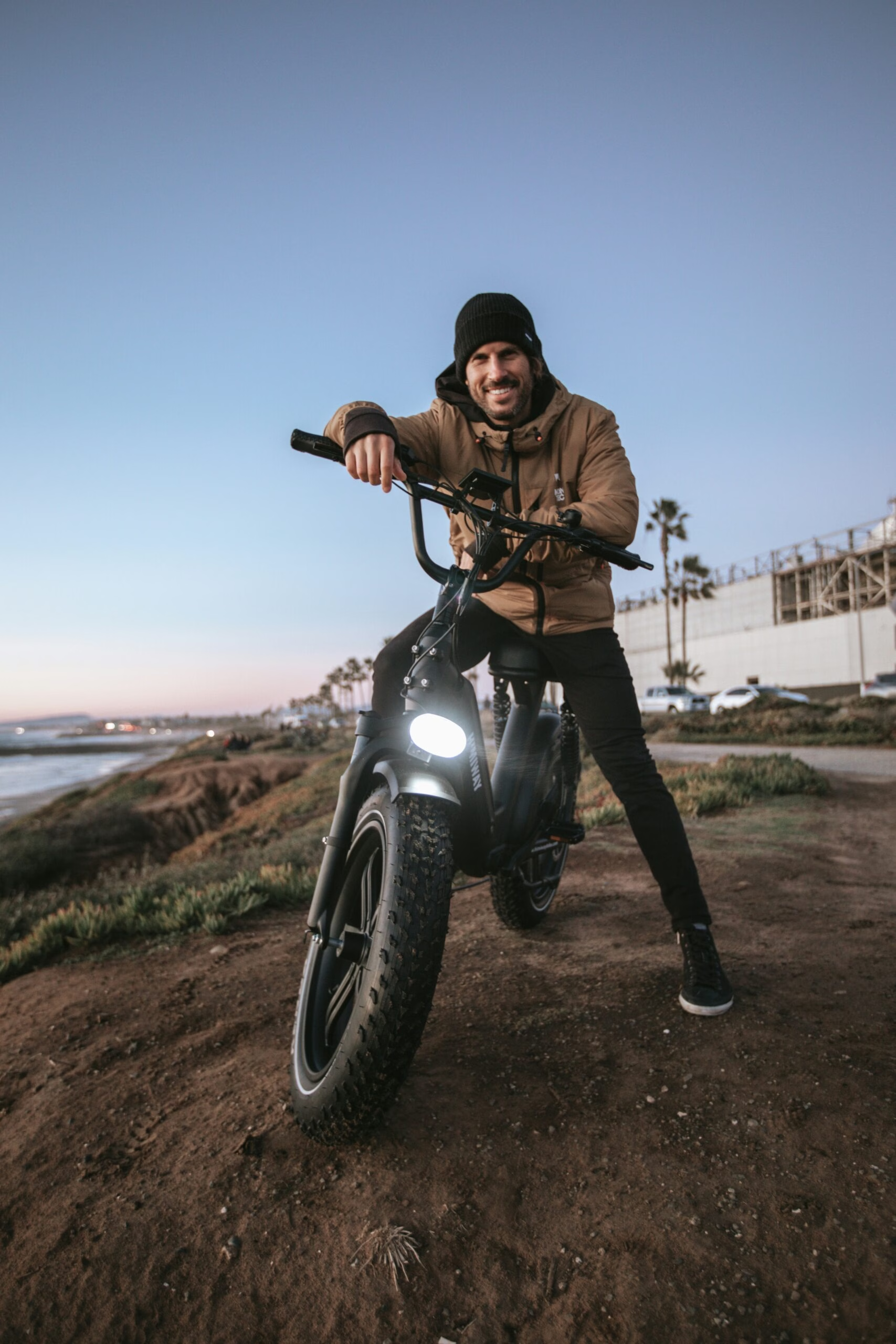
We won’t be too far off if we say that no one knows the boda bodas and African electric motorcycles better than Josh Whale. He has been around longer than. nearly everyone else. As the CEO and founder of Ampersand, he is a pioneer in electric motorcycles in Africa. The company has deployed nearly 8000 motorcycles in Kenya and Rwanda. Now they have opened their extensive swapping network to other manufacturers and announced that China-based brand, Wylex, would be rolling out motorcycles in Africa on Ampersand’s swapping network. InsightEV caught up with Josh Whale to understand his vision for Ampersand and African e-mobility.

Josh, it’s a pleasure to have you here for the InsightEV interview. I think this is an interesting time for Ampersand. Before we go on to the story we’re focusing on right now, I want to talk about your journey. Ampersand was the first entrant in the African e-mobility market. What really was the motivation? Why did you find Africa exciting? What drives you today? And where do you see this heading?
Josh Whale: The origin story was really driven by two things. First, I am a climate guy. I watched the Inconvenient Truth film when it came out, I think it was 2004 or 2006. It certainly made a big impression, as is the case for many people in e-mobility and the broader climate movement today.
I went to China because of that. The second thing is that I ended up working as an intellectual property lawyer and represented a lot of clients in the renewable energy and clean transportation space. At the time, around 2009, there were already a couple of hundred million of the very cheap electric scooters and e-bikes on the road. These had the classic lead-acid battery, 25 kph top speed, 25-km range, and couldn’t get up a hill at all because of the low discharge rate on lead-acid batteries.
It was also the year that Tesla came out with the Tesla Roadster, and electric suddenly became exciting and sexy. Until that point, it had been really viewed as clunky, nerdy vehicles that were not appealing and were very much a niche thing. But the Tesla showed what an electric vehicle could do: the torque and the acceleration. Tesla’s thesis, at least at the time, was something called the Hershey’s Kiss business model, which is actually a traditional approach for introducing new technology in the automotive sector: start with very low-volume, high-margin innovation (hand-made, expensive technical expertise) in sports cars. Hence, the Tesla Roadster. Next, build up volume and experience, and move to the next stage with a premium segment vehicle, which is still low volume but maybe 10x-20x the size of the super high-end sports cars. Eventually, that gets you to the mass market.
Seeing what I saw on the roadside in China, and seeing what was happening every nine months with the halving of the cost of lithium batteries, solar panels, and improvements in performance and scale economies, I looked at whether there was another way, particularly in the Global South where most of the demand for transport in the 21st century is going to come from. If we just sit and wait for this trickle-down Hershey’s Kiss approach to eventually make its way down to everyone, even below the Toyota Corolla level of the market, but really to truly democratize mass-market mobility, and also reach segments that are not passenger cars.
That led me on a search to look for where the unit economics were already sufficiently compelling so that we could make the shift to electric with existing battery costs as they were back in 2017. Battery costs have only gotten better since then, of course. It’s this search for unit economics that led me to the mass market—this very high-volume, high-daily-mileage, high-energy-spend market of commercial motorcycle riders in East Africa. A boda rider’s daily fuel spend is the single largest cost in their lives by quite a wide margin. Those riders typically take home two or three dollars in net earnings at the end of the day. Taking a 35-40% chunk out of their five-dollar-a-day energy costs on the energy side, plus cheaper maintenance and all the rest, was a huge and compelling value proposition for those riders.
On top of that, fuel imports specifically for motorbike riders are a colossal drain on hard currency and forex reserves for African nations. Fuel prices are also very volatile and macroeconomically destabilizing, as the last three years have painfully demonstrated. In East Africa, this is about a seven-million commercial motorcycle market. The energy mix is also well over 90% renewable: hydro, solar, wind, and geothermal. The mix is there, and there is an oversupply of power. The extra, unutilized electricity capacity is also very expensive for these countries. So, it was a perfect storm of unit economics: value proposition for countries, value proposition for individuals. That’s why we chose this market.
Back in 2014, we looked at a few countries in the region and zeroed in on Rwanda as having the most compelling unit economics of all, also for scale and density. We discovered that Kigali is a perfect match. Riders spend about 95% of their time within about 12 kilometers of the city center. We could serve that intensely densely concentrated fleet of around 35,000 riders, half of all the road transport in Kigali, with just a handful of relatively simple swap stations. The barrier to reaching positive margins was also very low in terms of CAPEX and operations. Kigali was the lowest fruit in a tree full of low-hanging fruits.
That’s an exciting story. You hit the nail on the head that most electrification would be driven by the Global South, and that’s where you are operating. Looking at your latest news release, which comes after you’ve gone public, you are opening your swapping stations to third-party operators. The first partner is Wylex, a manufacturer in China. That’s very interesting because I’ve always looked at Africa and wondered why people aren’t working together and why everyone is working in isolation. Is this the first right step toward collaboration? Would you describe it that way?
Josh Whale: What we discovered when we first came into the market in Rwanda was that there just wasn’t an available off-the-shelf battery pack that would deliver what African commercial riders needed. What is so different about the market here in Africa, compared to the light deliveries industry in India or Taiwan, with Gogoro and so on, is that the key drivers for the riders are not how the bike looks or its features. It’s very much analogous to heavy trucks or commercial delivery vehicles. It’s not about looking pretty; it’s about uptime, operating costs per kilometer, and reliability, getting there on time. That’s why motorbikes in Africa have historically been dominated not by the cheapest Chinese motorbikes you could get (not the $700 motorbikes), but by Bajaj Boxer BM100 and 150, TVS HLX or GLX125s, and Hero Hunter 150s. These motorbikes cost nearly twice as much as the cheapest bikes. That’s because the truth is that cheap is expensive in Africa. Our customers rely on these vehicles for their primary, often sole, source of income. Any interruption, especially with the low daily margins they take home, is incredibly expensive and disruptive. For the companies that finance those vehicles, 70-80% of the vehicles here are financed by third parties—they rely on both the vehicles and the batteries holding up over time and producing a net return that is competitive with a fuel vehicle. The vast majority of the African market is in that high-reliability, high-uptime segment, not the very bottom, cheapest end.
You talked about the ecosystem here. What we found is that we had to be a full-stack solution in the beginning because there weren’t the right vehicles, and there weren’t the right batteries. We actually had to go out and develop the world’s first production LFP battery for a motorbike or a three-wheeler. Everyone was still using NMC and NCA back in those days because of their lower sticker price and energy density. But the charging speed of NMC is a third that of LFP, so NMC requires far more batteries and the space to charge them. And the cost per kilometer of NMC was also far higher, because they last a third as long. We couldn’t use NMC and compete with fuel. And guess what: The whole world is moving to LFP now.; A funny story is that we had to use batteries that were actually intended for aviation backup systems; those were the smallest LFP cells we could get our hands on at the time.
Now, as we’ve progressed and proven that these batteries work for motorcycle manufacturers and customers, word gets around quickly. Riding a taxi or delivery motorcycle is an inherently B2B business and an inherently mobile, visible, chatty one at that. The vehicles run between 100 and 250 kilometers per day, and riders see each other to exchange information. If something is not working, if it’s not reliable, not safe, or if you can’t get a battery swap on time, word gets around. Furthermore, word also gets around among the riders’ clients, and they lose business.
Over the past two years, particularly driven out of China (although India is changing as well), motorcycle manufacturers, some pure electric, some traditional petrol motorcycles at the higher end of the spectrum, have looked at the market and spoken to customers. They see that this is clearly the way things are going. We’ve had an influx of about eight different OEMs come and find us in the past 18 months or so, partly propelled by the deal we announced last year with BYD. That is a wave we’ve decided to leverage as a growth multiplier, rather than try to compete with. We’ve opened up the platform so that there are a variety of different vehicles on offer, allowing us to tap into the benefits these companies bring: their partnerships, their distribution networks in Africa, and outside of Africa. We focus on what we do best and where we believe we’ve added the most value: battery design, the software back-end that manages this fleet of batteries and charging in real-time, the efficient swap network and operations we’ve developed, and the AI we use to manage all of these fleets reliably and in real-time, still far ahead of any of the competition. We let these other companies make great vehicles. We still build the favorite motorcycle on the market, and we have no plans to stop building motorbikes anytime soon. We also continue to vet anyone coming onto the network very intensively to ensure customers have the uptime, safety, and reliability they’ve come to rely on with Ampersand. We don’t want to see our brand diluted by poor customer experiences, and we take the trust riders place in us more seriously than anything.
What is your business model like? Do you sell the motorcycle and the battery, or do you lease it? How does it work?
Josh Whale: Ampersand is an energy business: That is where we have brought the most value to Africa’s transport revolution, and where we have mastered the true technical and operational complexity in the African transport equation. Because of the terrain, topography, loads, motor power, and distance, In Africa, total spending by commercial motorbikes on fuel is around five times the annual spend on motorbike sales.
Africa’s vehicle sales are also very different from India; African riders are almost entirely independent owner-operators. Additionally, around 80% of motorcycle sales are via financing from companies like Watu, MKopa, and Jali, as well as much smaller lenders and rider cooperatives. Our customers use their motorcycles as purely commercial vehicles. This is a bigger hurdle in India, where riders of similar 100-150cc motorcycles, like the Bajaj Pulsar or Hero Hunter, also use them as a family vehicle to travel a couple of hundred kilometers away once or twice a month.
I understand the asset finance partner would be very important because Africa has very high lending rates.
Josh Whale: There is a lot of currency pressure. There has been a lot of currency devaluation and depreciation in Africa, ironically because of high fuel prices, which probably more than anything else drives up inflation and borrowing costs. The cost of capital is higher globally, so the cost of debt for those lenders is higher, and the hedging cost or currency depreciation, because they’re paid in local currency, which may lose 10-20% of its value annually and is very volatile, has to be built in. Typically, default rates are very high.
However, we’ve seen far lower default rates with our vehicles. Something we offer to those finance partners, whether small ones through a manual online platform or through API integration, is the ability to prevent the rider from getting a swap if the rider hasn’t paid. It’s essentially a pay-as-you-go vehicle, and that has dramatically reduced default rates.
The other feature driving that low non-performing loan rate is that the demand for our vehicles and access to our battery swap network far exceeds what we’ve been able to supply. That’s simply due to the lack of equity capital in the African ecosystem. So any motorbike that’s repossessed is back on the road with a new rider in a flash. Theft also isn’t really a thing, since the motorcycles don’t work without coming to Ampersand for a swap, and the vehicles and batteries are tracked.
Josh, can you tell me about the battery pack? I understand it’s a big LFP battery pack. What is the capacity and the weight?
Josh Whale: The traditional batteries until now have been a 3.8 kWh pack, around 43 kgs. It’s quite bulky, big, square, and very utilitarian in design. We do have a new battery coming out next month, but I’m not at liberty to share any details yet; it is moving in a much lighter, easier-to-integrate direction.
Would the new pack be compatible with the old motorcycles?
Josh Whale: There is a retrofit required at a moderate cost, but the existing batteries are working perfectly well, and any existing vehicle can quite happily continue to use those packs.
Are your swapping stations manned? Does someone have to assist in swapping the batteries?
Josh Whale: Yes, they are. The new batteries offer more flexibility because they are more compact. But in general, in Africa, it’s not cheaper to replace a human with a robot. TotalEnergies is one of our investors and hosts dozens of Ampersand stations. They informed us that they don’t have a single self-service petrol pump in Africa. It’s much more expensive and less reliable, depreciates faster, and riders expect a human. If you’re not saving riders money by taking humans out of the equation, you are just making a lot of people unemployed and invariably creating a worse user experience, just so companies that aren’t really adding much value can pose as a tech company on a pitch deck. We’ve also found that the economics of battery swapping here favor building much larger stations that have their own dedicated transformers. They are busy places, perhaps with 200 chargers, delivering close to 200 batteries an hour.
You announced a partnership with BYD for the battery cells. How is that going, and what advantages are you getting out of it?
Josh Whale: BYD came to us in the context of the tariff barriers going up in the US and Europe. They essentially said that the Global North’s loss is the Global South’s gain, and they are now looking around South America, Latin America, South Asia, and Southeast Asia, asking what local companies want to do. Like the other OEMs, they looked at the market and said Ampersand clearly offers the most reliable, proven, and mature product stack in the market. What the partnership has brought to us is access to their vast scale economies and their engineering teams, particularly for design for manufacturing and design for assembly. We are very excited about where this partnership can continue to take us next.
The new partnership with Wylex means they will deploy their motorcycles with the Ampersand battery and use your swapping network. This implies they developed the motorcycle around your battery pack. Is that correct, and would any future partnership have to work similarly?
Josh Whale: That’s right. We are open to working with OEMs and their distributors, provided they are producing high-quality, durable, reliable batteries. We also feel a real duty of trust to our customers and our communities. Africa benefits from lower regulations and standards thresholds than other markets, which have allowed this sector to move quickly and innovate very freely. But that freedom comes with a duty of care, a quid pro quo to take care of our riders, passengers, their families, their countries, and their cities. And not just dump low-quality, unsafe vehicles on the market. Sadly, not all companies in our sector in China and Africa have acted with that duty of care.
With the rigorous vetting we’ve done on spare parts availability, product quality, and safety, anyone is welcome to use our network. For a company like Wylex or anyone else, they have the option to work with us. Additionally, we don’t require them to only put Ampersand bikes on our batteries and network. We are not about monopolies, and we don’t believe the market or regulators will support it. Anyone who thinks this industry is simply a ‘razor and blade’ story hasn’t been paying attention. That’s simply not how motorbikes or fuel for motorbikes work in Africa, and not how network effects work in motorbike charging either. It’s also a huge growth multiplier and de-risker if anyone financing a motorcycle knows that if this energy provider isn’t a good fit, or if they end up disappearing, the customers have alternatives. That brings a huge level of comfort, especially as the technology has been progressing so quickly, and there have been, unfortunately, a lot of very bad batteries out there performing very poorly. The optionality of being able to switch from one provider to another, even on a vehicle once it’s on the road, is a really important feature of this partnership.
Here, Africa can learn from India. In India, regulators attempted to make it so that every battery should be able to be switched out of every vehicle and swapped at every swap station. That is completely unfeasible in reality; it’s a product warranty issue and a safety issue. If a Roam motorbike rider comes to Spiro with a new Ampersand battery, what is Spiro meant to do? Who is liable? How much do they charge the customer? How much does Ampersand get for that? Standardizing something as complex and potentially hazardous as a battery is not like a USB situation or even different electric car charger standards. There are a thousand more variables that go into a vehicle and its operating system and safety than a plug in a socket. The analogy is probably much closer to something like GSM and cell phones switching from one provider to another. You can buy a Samsung and choose between Airtel and Safaricom with less inherent lock-in and network effects than you get with cell service and mobile money service. We expect the market to land in a situation where there is freedom to choose, and also freedom to switch with a modest switching cost.
How big is the swapping network right now in Kenya and Uganda?
Josh Whale: We have close to 70 swap stations, but we’re adding new ones all the time. This is serving a fleet of vehicles that will surpass 8,000 by the end of this year in those two cities. We found that fewer, larger stations at key locations and dedicated transformers make far more practical and financial sense than Swaps. We are not overburdening already overstretched local electricity lines. We don’t need hundreds of individual sites, installations, connections, and landlords to serve a small number of vehicles. We believe we can serve all the motorcycles in Nairobi, maybe 200,000 or 300,000, with fewer than 200 locations quite effectively.
I recall that you had also started using solar energy with your swapping station. Is that true?
Josh Whale: That’s right. We have a partnership with CrossBoundary, which both finances and deploys Commercial & Industrial (C&I) solar across Africa. Solar is a complement to the stations that we have. However, the amount of power we actually deliver, currently around 60 megawatt-hours of electricity every day, is not terribly practical or economical to provide entirely out of solar. It also ties up a lot of CAPEX, and the equity capital has just not been there in Africa to sustain that sort of an investment.,
It does, however, reduce energy costs to roughly 15 cents per kWh. Falling battery storage costs are also a game-changer, including second-life Ampersand batteries. Lower overall cost of solar also opens up new markets that were previously unfeasible due to a lack of electricity.
But solar, and even the cost of storage, thanks to the falling LFP battery prices, is definitely much more of a contender than it was when we started.
What is the situation with batteries and associated reliability?
Josh Whale: I think the elephant in the room is around the batteries and their reliability. You have a lot of producers, largely from China, offering batteries and claiming they’ll do everything quite happily. What we’ve seen from the samples we’ve received and tested, and what we’ve seen from customers of other players in the market, is that off-the-shelf technology just hasn’t progressed to a point where you can dependably rely on it. That’s understandable: You’re talking about an absolutely punishing life for a battery, riding up and down the length of Africa 30 times, often on rough roads under heavy loads. While the sector is growing quickly, some of our main competitors appear to be masking the problem by flooding more batteries into the problem. Sure enough, within weeks, customers are left stranded again. That’s completely unsustainable financially.
You hear a lot of talk about companies boasting of reaching EBITDA positive or positive gross margins. That’s great. But it’s just the first step. Without the ‘DA’ (depreciation and amortization), we are not seeing the full picture. Anyone interested in the sector and looking to invest needs to understand how well those batteries are performing over time as new technologies emerge. They should bring on engineering expertise from consultancies, where appropriate, to vet the design of the batteries. But you should run a cohort analysis, looking at revenue retention rates on vehicles and batteries that hit the road two years ago. If you can see that a large portion of them are no longer providing revenue 18 months, two years later, you might want to reconsider writing that check. And finally, just ask the customers whether the battery swaps are prompt and reliable. They should also check if the vehicles are still running year after year. I think this is where some of the other companies have fallen flat.
It’s partly a function of the nature of the investment ecosystem here. We greatly appreciate our investors at Ecosystem Integrity Fund, Beyond Capital Ventures, Factory E Ventures, SeedStars Africa Ventures, and Schneider-Electric-backed Gaia Impact, who both a) understand and support the R&D investments that companies like us want to make; and b) are also comfortable investing in businesses with assets on the balance sheet. They understand that you aren’t going to fix climate change in Africa with software; you actually have to invest in hardware and infrastructure: swap stations, batteries, and the renewable energy infrastructure to decarbonize transportation on a continent that will have two and a half billion people in 2050. You need to get the technology right, across thousands of variables, to even have a viable business..
It’s easy to go to China and get a motorbike. It might even save someone money for a few months. But keeping those customers safe, happy, and moving is another matter entirely. On top of that, the technology is moving quickly. Our R&D team has reduced our CAPEX needs by 50% over the past 18 months, partly through the partnership with BYD and leveraging that through customization of components. This includes moving from off-the-shelf, top-end Battery Management Systems (BMSs) to packing more functionality through predictive AI to predict battery health, predict demand across the network, ramp up charging speeds, and ramp them back down when things can rest. This means fewer batteries in the fleet, batteries last longer, and customers have a better user experience. These are very direct, internal cost savings that are dramatic and provide a major cost and performance advantage over competitors.
The analogy of building a cell phone network, the J-curve of building infrastructure, and then reaching critical mass, is apt. But it’s not like telcos today. It’s more like telcos in the mid-to-late ’90s, where technology is moving in big leaps and bounds, such as the shift from TDMA to CDMA. These big step changes, which made companies like Qualcomm incredibly valuable, are still very much happening. If you’re behind on those innovations and lack the capacity to understand and integrate them, you’re just going to get left behind with a fax machine. And thirdly, there is a huge degree of operational excellence, data, culture, integrity, and experience that we bring to keep riders safe, moving, and happy over 100x the length of Africa daily, and build out a brand riders are glad to rely on to put food on their family’s table that evening. That doesn’t get built overnight. So, it’s a marriage of the infrastructure (CAPEX), the technology, and highly complex and optimized operations.
It was my pleasure to have this chat with you. I think you are based in Kenya, I believe!
Josh Whale: Likewise, I’d love to, and if you ever make it out to East Africa, please do come visit us. Include Kigali on your itinerary. I am personally based in Kenya, and this is the longer-term, obviously much larger market than Rwanda. But most of the team is based in Kigali. That’s where we do the assembly, a lot of the steel fabrication work, the battery development, and software, and it’s where we have our largest fleet by a factor of three.
Great. I look forward to that. I should be making my way there in the first quarter of next year, so I will definitely ping you to plan things.
Josh Whale: We would love to pick your brain about other markets, including India. A few years ago, I was lobbying Indian manufacturers to come and build a great motorbike for this market. We happily share everything we’ve learned about product requirements, specs, which motor is working well, and which controller manufacturer to use, all for free, if they would build a great motorcycle for this market and leverage their distribution networks.
Understandably, because of the big boom, or big bubble, depending on your viewpoint, in India, with Ola and Ather, they said they have a huge market of annual sales. For them, it is about sales, not swap revenue and energy; they are not in the energy business. They could use almost the same lines to produce and sell great scooters with their own batteries from their dealerships in India, making a great business out of the 22 million annual sales of two-wheelers in India, versus Africa, which is maybe seven million a year. I totally understand that standpoint. Unfortunately for India, that has left a gaping opening for China, which obviously has massive advantages when it comes to the global EV industry.
India is currently far behind, following a much more traditional two-year product development cycle. There is also a bit of sunk cost fallacy around the 48-Volt architecture India has built on. You can build a powerful motorbike on 48 volts, but it puts you at inherent cost disadvantages and a far smaller selection of components. You need much more copper cabling and different components because you are pushing so many amps through the powertrain. China is on 72 Volts, and that is the way it is going. Trying to power a two-wheeler with 48 Volts is like trying to power a diesel truck with five petrol engines strapped together; you can probably do it, but is it the winning strategy? No, not really.
A few years ago, I visited a large OEM in India. They essentially said that what we have developed in Africa—the ‘diesel engine’ of electric motorbikes, the big square yellow box, which evokes a Caterpillar or Komatsu, built for uptime, cost per kilometer, reliability, and all the infrastructure in the back-end to keep that thing moving, is what they need in India for three-wheelers. That is the sort of use case where we are also starting to cast our eyes beyond Africa’s shores.
I think Indian manufacturers have always been too busy with the local market. We analyzed that many weeks back. We said that if anyone should be worried about Spiro’s USD 100 million fundraise, it’s not Ampersand or Zeno or any of the local African players. It should be Bajaj Auto or TVS that should be more worried about the Spiro fundraise because they haven’t got a competing product; they don’t have any product there at all.
Josh Whale: We certainly provide a solution, I suppose, in that analysis, to those Indian OEMs that are ready to wake up.
“Hey, we’re open. Meet the criteria, and you can build a great motorbike and use our network. We have been open to you for five years. We’re still waiting.”
Indian OEMs are slowly waking up to the promise of Africa. At least a couple of them have strategies for Africa. They don’t have a product coming for Africa; they have strategies coming for Africa, and that strategy may be investing in the local manufacturers.
Josh Whale: A couple of them have made small investments in the market. That’s one route. I think what has happened is that since the wind has gone out of the sails of Ola and some of the other companies, and those big OEMs have managed to consolidate their positions, they have really good products with very strong market share. In the case of TVS, they are now able to shift focus back to Africa. They’ve also been developing three-wheelers, so that’s a whole area that we are also expanding now. We have two different OEMs, not Indian, building three-wheelers that are also capable of using our network.
I think that is an interesting market. How big is the three-wheeler market in Africa, and is it electrifying fast enough?
Josh Whale: I mean, certainly large enough. We haven’t seen big inroads. There’s a company in Dar es Salaam that is doing it with three-wheelers. That city has a pretty big three-wheeler market. It’s probably about 10% of the size of the petrol motorcycle market in terms of units, maybe 15-20% of the size in terms of energy sales, which is really what we’re focused on. It’s significant, but it’s just not the biggest market in Africa.
I should probably mention a key difference in comparison that might interest your readers. From our analysis of the Indian market, the fuel and energy sales relative to vehicle sales are at approximately a 1:5 ratio of vehicle sale revenues to fuel because it’s primarily a consumer market that is growing quickly, and margins are much higher on vehicles with features and more horsepower, and so on.
Africa, it’s basically the reverse. It’s about five times. Every year, a rider will spend between $1,300 and $2,000 on fuel, and another $200 on oil changes on top of that, which is pretty much the same cost or usage profile. They will buy a motorcycle for $1,500, and that motorcycle will be on the road usually for at least five years in the most intense use cases, or seven years. Otherwise, a lot of the margins for the OEMs and distributors also come from spare part sales, and so on. So that’s another 20% on top of the vehicle sales. But the energy market dwarfs the motorcycle market.
I think that’s a direct result of how many kilometers the normal Boda Boda rider is traveling every day, right?
Josh Whale: Yes, the kilometers, the horsepower, the load. Carrying a human or bulk cargo is obviously a lot more than carrying a biryani on the back of a delivery bike. The user context and needs, the demands on the vehicles here, and the power requirements are an ocean away from the cheap little scooters doing commercial work in India.
You see all kinds of amazing things carried on motorcycles in Africa. And on hilly terrain, Kigali is a very hilly city, and so going up and down like that means you need a lot more power. There’s a lot of energy consumed. And then on the downhill, the regenerative braking, especially at the 10% regen we can get with LFP, the charge and discharge rates with LFP are also roughly 3x higher. That’s all part of why we need far fewer batteries and far less battery CAPEX in the network than our competitors. Anyone stuck with 48V or NMC batteries is now eight years behind us, and doomed to be left behind with the steam engine and the fax machine..
I think it’s a very challenging as well as an interesting market, and I’m so happy that the market is electrifying fast, because the number of people and the number of lives that are going to be impacted by that is much more than what you can do with the electrification of two-wheelers in the Western world.
Josh Whale: Absolutely. The urbanization and population growth Africa will experience in the next 30 years is unprecedented in the history of the world. Even if Lagos, Nairobi, and Abidjan were in the most developed countries in the world, they would be hard-pressed to build the necessary infrastructure fast enough through traditional forms of public transport, to build the road infrastructure for cars. That would be a herculean task: Twice what China has achieved since 1995, on a fraction of the budget. Obviously, Africa is not that well off; its access to capital is less, and the cost of capital is much higher in these countries. So motorcycles are set to still play a really important role in moving people around. They also take up far less road space than a car does. But it’s critical that they electrify. The vast majority of Indian and Japanese motorbikes sold in Africa today are basically 1970s tech, and don’t comply with the emissions and braking standards of their home countries. That means exponentially more pollution than modern cars produce, and many avoidable deaths.
When we were interviewing the EIF, we sort of wrote about Ampersand opening its network. So that was in October?
Josh Whale: Given that we have other stories going out, I’ll be very happy to give you a heads-up when we do the new battery launch.
Yes. Definitely, we would like to be in the know.
Josh Whale: I think a new battery that’s lighter and more compact is interesting, but I think the broader story around the economics of battery swapping, the network, and when things do and don’t make sense in this market, and the role of cabinets, and so on, there’s a more interesting story there.
I think we would like to do a deep dive on that. That’s one of the reasons why I’m planning to travel to Africa in the near future to look at the battery cabinets that are popular there. It’s very different from the Gogoro ones or the ones used by some other players here. And you would know it, obviously, because you have been there longer than anyone else.
Josh Whale: I think it’s worth doing, because also what we’ve seen with some of the safety-related issues and performance issues on some of the other companies out there. You really have to get on the ground and talk to riders, talk to the finance people they work with, to get the real story. Unfortunately, there’s quite a gulf between the press releases that we’ve seen from some of our competitors and the reality of their businesses, hardware, and customers on the ground.
Look, safety and basic quality and performance are not a point of difference we really want to have, because it is now having knock-on effects for regulation coming into the sector, setting a lot of noise about setting prescriptive standards. In a market like Rwanda, where we’ve been on the road for so long, it’s much less of an impact because the government is fully on board. They understand; they have a deep level of understanding. They go out and talk to customers and see what’s working and what isn’t. But in most of Africa, where e-mobility is more nascent, it’s a different picture. In some cases, the electric transition in Africa could be held back by years.