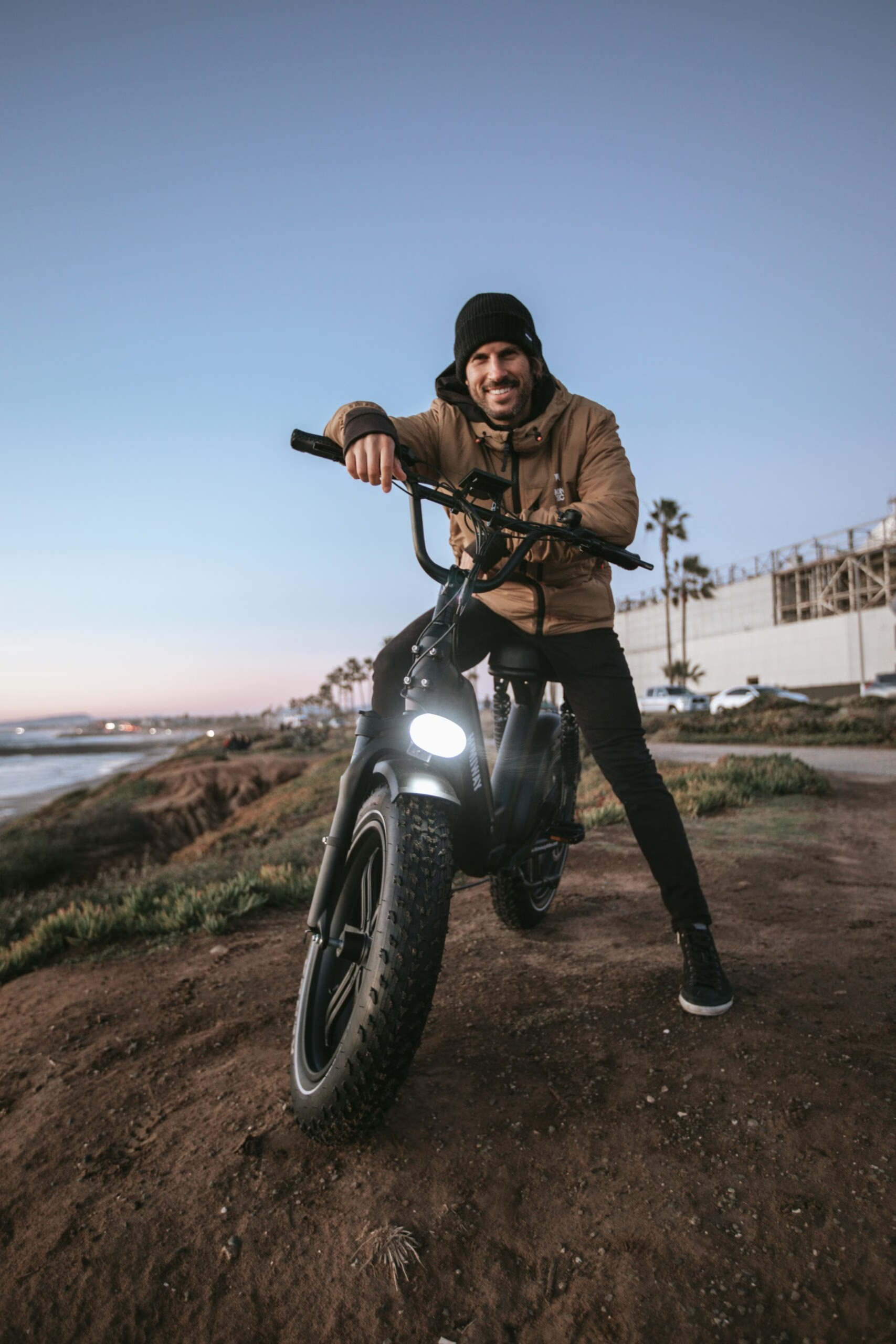
Recent media reports about Zero Motorcycles caught our eye. To provide you with context, here is what Buck City Biker reported.

It looks like Zero released a media release about their 2025 numbers, as similar reporting was also done by other outlets.
But what did you notice in the numbers?
Well, first, Zero gives us zero information. Sure, there are a lot of percentage gain claims, but without giving any base information, we actually do not know how many motorcycles Zero sold in 2025. 89% of X is 0.89X and is as meaningless as X if no one wants to disclose what X is. We understand that Zero is a privately held company and doesn’t want to put its sales numbers in the public domain. But this kind of media coverage is frustrating and meaningless.
Apart from the mockery of numbers, another thing we captured was that the X that we know, that is, the Zero X-line, now accounts for 30% of Zero sales in North America in 2025. That’s big considering it was introduced in 2025 and deliveries commenced in July.

It indicates a pivotal shift in Zero’s product mix, from large and expensive electric motorcycles to small, cheap, and fun e-motos. Since then, Zero has also unveiled a scooter. The two X-line motorcycles and the scooter are not really Zero products. They are sourced from China, the X-line coming from Zongshen, one of the biggest Chinese suppliers around.
That’s not just a change in product mix; it is a pivot in the company’s strategy and the core thought that made Zero the poster child of electric motorcycling. It’s no longer about making large, capable, technology-heavy motorcycles. They clearly don’t sell much. Instead, the focus has moved to sourcing cheap motorcycles and scooters from China and keeping the company ticking.
Livewire is Not Much Different
Things are not much different at LiveWire. The One was not the one, so they had the S2. The S2 was supposed to spearhead a full range underneath, all carrying some form and elements of the famed Arrow platform. The Arrow platform uses a structural battery pack for lightweighting. Capable yet expensive, the S2 range has been a slow seller.

However, the S2, like the S1, has been a slow seller. Sales have picked up somewhat after Livewire cut prices. The company’s hopes now rest on the upcoming S4 Honcho range, smaller, 125cc machines that are more minibikes than real motorcycles.
The Honcho range is not just smaller in stature; it is also a clear departure in terms of technology. The structural, fixed pack is replaced by removable packs. Admittedly, the S4 Honcho looks good, but it is nowhere close to the S2 in character.

But that does not take away the fact that the much-awaited range of small bikes is what will hopefully get Livewire charged again. Like Zero, there is a change in the core character of the company towards smaller, more accessible machines. The difference is that the S4 range is an in-house development and not picked up from China.
Between Zero and Livewire, we see an electric big motorcycle company failing to be replaced quickly by an electric small motorcycle company.
But What About the Other Big Motorcycle Companies?
At the very top end of the spectrum is Lightning Motorcycles. They have been around for years, but it’s tough to find real user or media reviews online. They also hold the record for the fastest production motorcycle, but we can’t find any real-world sales numbers. Some media define them as a boutique big-electric-motorcycle manufacturer.
But then who isn’t?
Except, unlike Livewire and Zero, Lightning does not have any visible large financial backers. At some point, Lightning’s small volumes would be a big handicap. They would need a steady revenue stream.
That time seems to be now. Lightning now wants to license its EDGE hardware, a modular 800V architecture that the company has developed for its Race program.
Mind you, Lightning’s production motorcycles run on 400V, so this is a more advanced development.

For anyone looking to source, this means access to a high-voltage architecture that can potentially underpin 200 PS+ (150 kW+) motorcycles. Obviously, battery technology, till we hit solid state, remains a challenge. But, for any wannabe motorcycle startup planning to develop a high-end motorcycle, to be able to license an 800V architecture off-the-shelf is a privilege.
In the same breath, we would like to point out that you’d be rather daft if you plan to create an electric hyperbike and don’t want to do the tech stack yourself.
But, for Lightning, licensing the tech stack seems to be the only plausible way to make money. It is metamorphosing from a motorcycle manufacturer to a tech stack supplier.
Something that is even more critical for Damon. Unlike Lightning, which likely has some motorcycles on the road and some customers in the pipeline, Damon has no such luxury. Its motorcycle remains elusive, and so selling its tech is the only way to find a future. It’s difficult to say how successful Damon has been in this effort. Considering that the CFO has just quit, we don’t have too much optimism.
Verge Shows the Way
Both Lightning and Damon would do well to look at Verge, a company that has actually done well in offering its tech stack to others. It has real customers. Customers who pay.
Realising that Verge would remain a niche endeavour. The Lehtimaki brothers created Donut Lab, a sort of overarching corporation that is responsible for all the tech that goes into the Verge motorcycles.
Donut licenses the Verge tech stack to others. This includes the inside hub motor that we will now also see in the Hush Cycle Superior GT, the battery pack, and the electronics. They even created the Donut motor in other sizes to fit different form factors. With Donut Lab announcing a solid-state battery, the technology licensing is only going to get more intense.
The solid-state battery is what may actually give Verge Motorcycles the wings and the edge over the others. However, with every big electric motorcycle manufacturer staring at sales that did not happen, offering the tech stack is the only survival mode.