The Premium Electric Motorcycle was a Figment of Magical Thinking. It has not worked. It likely would not for a long time.
Michael Uhlarik, noted motorcycle designer, and part of the InsightEV advisory board, talks about premium/performance electric motorcycles and how they have not really worked out…for obvious reasons. Michael published this on his highly recommended Substack a couple of days back and we are fortunate to share this with our readers.
Sometimes the motorcycle industry hands you an observation that cannot be ignored. This month it’s the failure of premium electric motorcycles, courtesy of LiveWire. They, along with Zero and Can-Am, are all quietly admitting through savage price cuts and incentives what riders have known for a long time: premium electric motorcycles as a category have not worked. Not commercially, not culturally, not by any metric that matters to a manufacturer’s balance sheet. The proof is not in some zinger by an influencer or headline in a press release.
It’s in the fire sale.
The Signal Above the Noise

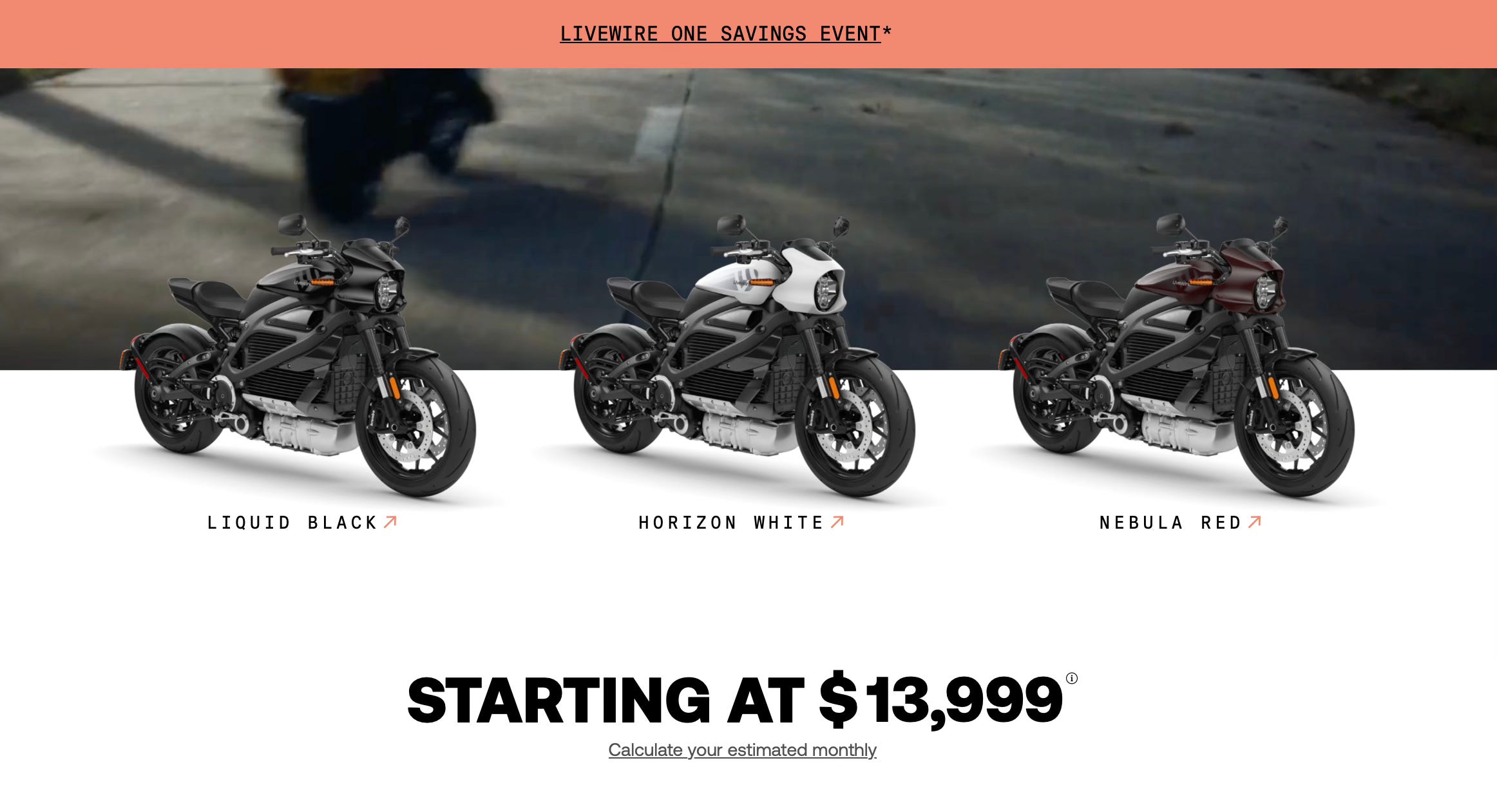
Let’s look at LiveWire, because nobody has been more honest – inadvertently – about the scale of the product-market fit problem than them. Introduced as a Harley-Davidson concept in 2013, then launched six years later in 2019 at $29,800, the LiveWire was cast as a halo vehicle signalling the hundred-year-old legacy company’s confidence in technology and the future. In the seven years since, LiveWire was spun off as a separate company, had a CEO leave prematurely, was largely re-absorbed into Harley, received a NYSE delisting notice, and that same motorcycle – largely unchanged – is now being sold for $13,999. That’s not a sale. That’s a 53% haircut on the original sticker, which is closer to 60% once you take into account inflation.
A review of major motorcycle sale aggregator websites reveals more than sixty LiveWire motorcycles for sale worldwide with less than 1000 kms on the odometer. Dealers in America, Canada and Europe have new or nearly new models on showroom floors that are four and five model years old listed with 40%-60% discounted prices, just to clear floor space.
With the factory now offering identical 2026 model year motorcycles at similar prices, those older unsold units, plus all second-hand ones, will face even greater depreciation.

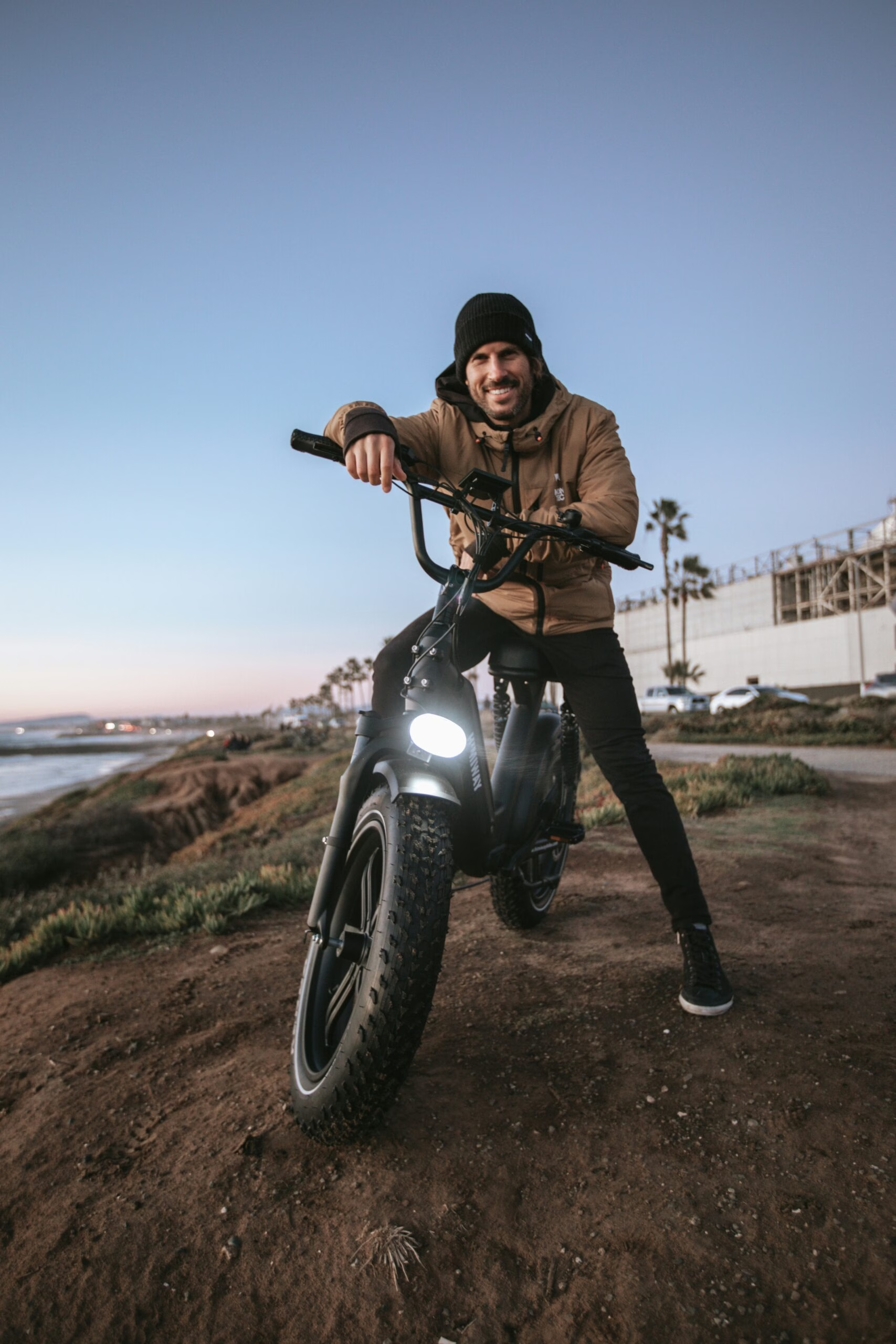
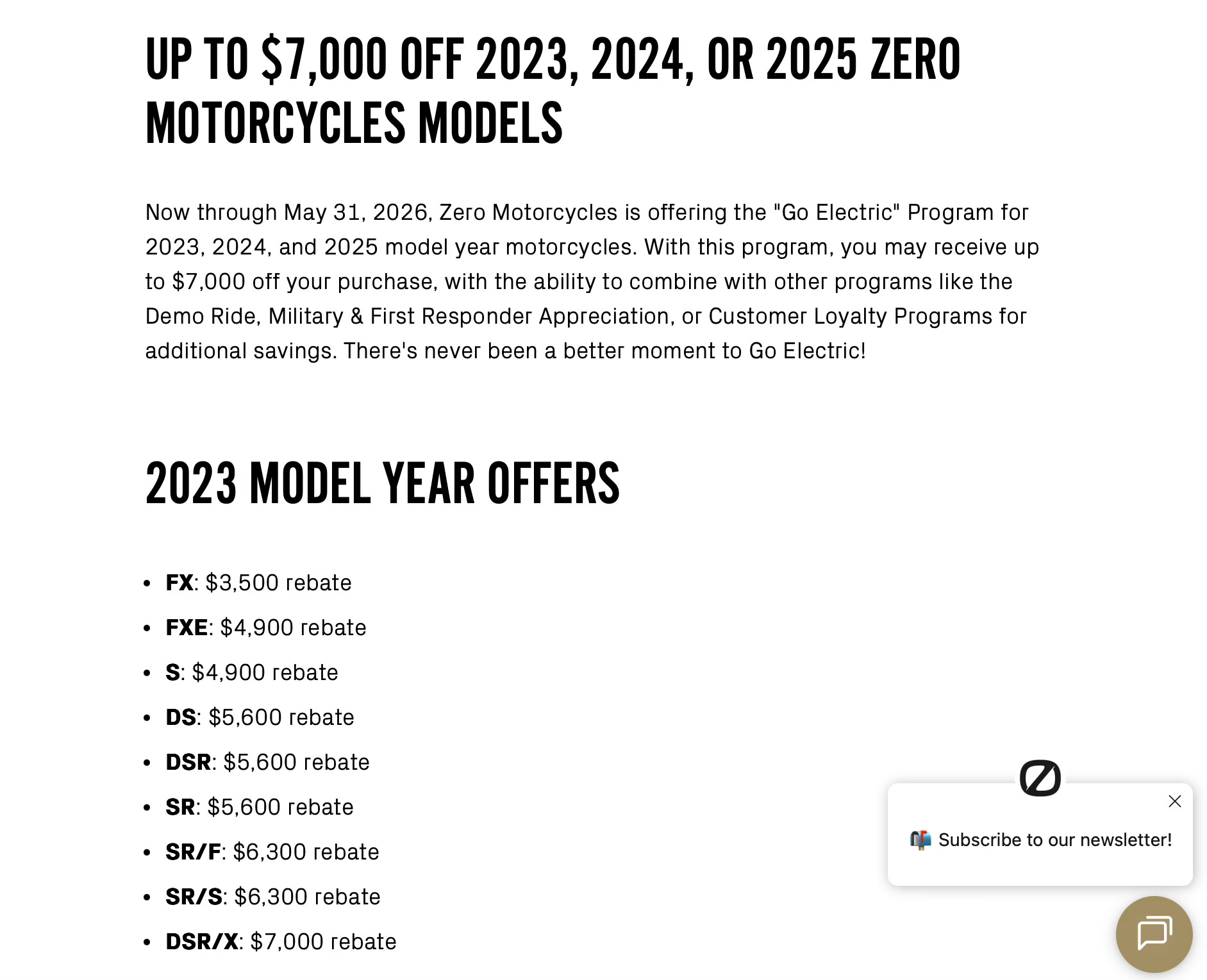
Earlier this month, Zero started running ads in Europe that offered €500 to anyone who bought one of their larger models as their “first motorcycle”, in addition to the steep discounting that has been as high as $16,000 on $29,000 motorcycles. Zero advertising earlier this year, on its own website, listed 2023, 2024, and 2025 models as available with prices slashed by 30%. Zero introduced the X-Line lineup of lightweight off-road and dual-sport models in the $6000 price range last year, hoping to compete in the high-demand sector dominated by Surron and Talaria. When a company that spent two decades declaring itself the premium segment pivots its growth strategy to bicycle-adjacent price points, it tells you where the demand actually is.
Finally, there is Can-Am, the newest and, on paper, most credible entrant. The Pulse and Origin launched in 2024 with a lot of solid engineering behind them – all in-house developed, fully liquid-cooled powertrains, batteries, and automotive-grade UX and software features. They arrived at $13,999 and $14,999. Within six months of their very first year, Can-Am was running factory rebates as high as $4000 and $5000 – nearly 50% off – on brand-new units.

Not clearance stock. Launch year inventory. This is not an aggressive promotion to capture market share; it is a manufacturer discovering in real time that the price didn’t match the value proposition, and moving quickly before the depreciation curve did more damage.
Here is the point that EV cheerleaders and naysayers both get wrong: this isn’t proof that electric motorcycles can’t work. It’s proof that North American OEMs haven’t accepted the motorcycle market for what it is, rather than what they want it to be.
The Product/Market Fit Problem

A $14,000 Pulse with 47 horsepower and a 120 km (80 miles) combined range is competing, on price, with a large selection of 700cc middleweights that will run circles around it on any real road all day long, for a lot less money. Or, as one Harley-Davidson dealer recently recalled, it is very difficult to make the case for a $30,000 LiveWire One, when for the same money you can get a Road King and have money left over for a road trip.
All of these are examples of egregious, textbook failures of product-market fit. They ask riders to pay premium prices for motorcycles that cannot deliver premium experiences, or sometimes even experiences equivalent to middle-market rivals powered by gasoline. No amount of app connectivity, inches of touch screen, or so-called “tech” features can make up for motorcycles that use discount spec components, middling performance, and Ducati Panigale prices. These companies have discovered that you can label yourself “premium” all you want, but don’t be surprised when, after you ask riders to pay premium prices for mediocre offerings, they say no thank you.

LiveWire sold 653 motorcycles in all of 2025, across two models. Sales data for Zero and Can-Am are unavailable, but based on the near total lack of current model year promotion, the factory fire sale discounts, and the unsold, dust-covered units languishing in dealer showrooms, it seems probable that the volumes number in the low thousands.
The global motorcycle market has grown consistently for years, north of 65 million units. The share of electric motorcycles (real motorcycles, not e-bikes or mopeds with pedals) reached 13% in 2025, growing at double digits. The segments where road-legal electric motorcycles are in demand are commodity commuter machines, the performance equivalents to 250cc or 300cc gasoline models, and recreational niches where either a specific style or performance gives electric platforms advantages.
The Stark Varg, at $13,900, represents the ceiling for premium, high-performance electric motorcycling at the moment. Stark has grown rapidly, shipping over 10,000 units and turning a profit, while winning accolades from electric motorcycle fans and doubters alike. The Varge looks, feels, and runs better than the equivalent 450cc motocross and supermoto rivals powered by gasoline. In the middle are brands like Maeving, Beachman, and other retro-classic roadsters that sell the image of cafe racers to beginners, but with a twist and ease of use that a conventional combustion motorcycle can’t touch. They are also priced to match their neophyte audience’s expectations. Off-road, lightweight electric motorcycles are a huge hit in the US, with 45,000-63,000 unit sales of $3000-$5000 Surron-style dirt bikes in 2025. When electric motorcycles are being called out by the Wall Street Journal, then the market signal is no longer a hypothesis. It’s a blaring air horn.
The Inevitable Becomes Unavoidable

Examining the evidence: sales performance, manufacturer behaviours and market reactions, mainstream and specialty press, the conclusion seems obvious. Premium electric motorcycles, as they exist today, have not matched the expectations of buyers, period. Pricing is an issue, but it is far more than that. The experience that motorcyclists got from LiveWire, Can-Am, and Zero was nowhere near the expectations set by the lofty marketing promises of those manufacturers.
The problem is not electrification. The customers who are driving electric motorcycle sales worldwide are attracted to the ease of use, lower operating costs, modern technology, and a desire for casual motorcycling. They do not want to invest in a techno-hobby horse that costs as much as a compact family car. No amount of software sizzle or premium brand marketing gimmickry can challenge that simple equation.
Premium motorcycle pricing only works when the vehicle delivers exceptional value in the eyes of the buyer. That value often comes from intangibles like brand history, racing success, perceived and real quality, and of course actual performance.
The Stark Varg nails performance. It is simply better than an equivalent gas-powered off-road motorcycle in its niche. The River electric utility moped is designed in India, for India, and backed by Yamaha. It sells practicality and assurance. Yadea, the world’s largest electric motorcycle manufacturer, delivers unrivalled value for money.
Livewire, Can-Am, and Zero miss on practicality, value, performance, and quality, and try to make up for it by spinning tales of heritage and adventure that the user cannot replicate or doesn’t care about. They targeted mythological young adults who supposedly had $20,000+ in disposable income to spend on unproven, unknown motorcycles with the performance of a $5000 gasoline commuter. They genuinely believed that with enough sophisticated, urban branding, and pointless app functionality, tens of thousands (hundreds of thousands in LiveWire’s case) would stampede to buy these machines.

They were wrong. And they ought to have known better. Motorcycle sales are not driven by fever dreams, no matter how many times one reads Zen and the Art of Motorcycle Maintenance, or attends a craft beer-soaked hipster bike event.
Motorcycle sales are driven by deep-seated needs, dominated by inner fears. “Am I cool enough to be seen on this? Can I ride this to work and not be made fun of? Can I afford this? Am I skilled enough to avoid injury…?”
Simply designing a niche electric motorcycle and pricing it like it was a Hèrmes bag never followed that logic. This is why the serious manufacturers have not gone there. Yamaha, Honda, Niu, Yadea, TVS, Hero, and other global OEMs all focused on electric motorcycles that meet the needs of commuters, and only now are pressing upwards as the technology improves.
TL;DR: Electrify the motorcycle all you want. Just don’t ask consumers to pay Ducati superbike money for off-brand commuter bike capability. Manufacturers must meet the market where it is, and not demand it meet their projection spreadsheets. No one is buying into these OEM fantasies.