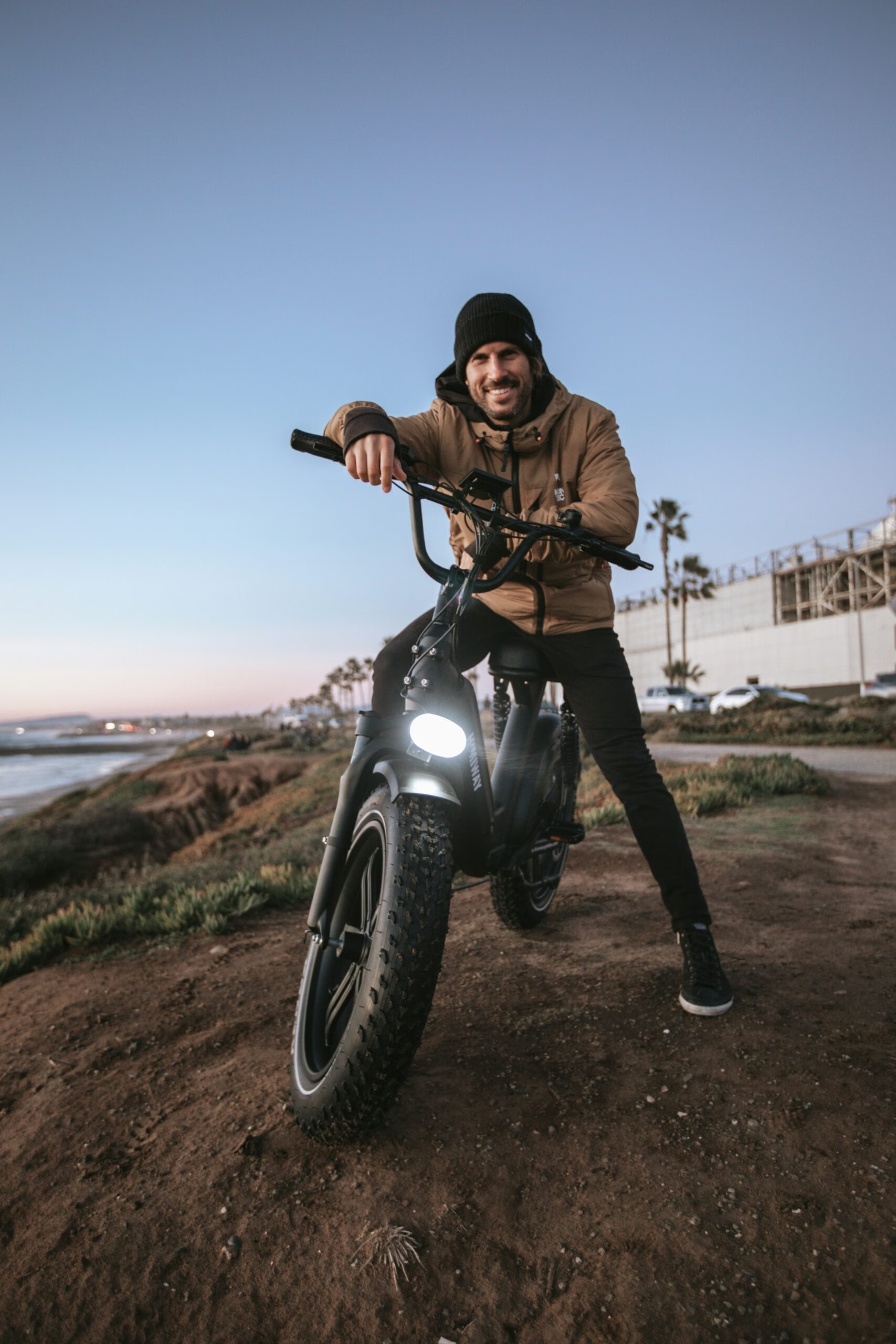
Africa is fascinating: sub-Saharan Africa, particularly Kenya, Uganda, and Rwanda to the east, to Nigeria, Benin, and Togo to the west, offers some of the hottest opportunities for electrification. Grids have relative maturity; some are incredibly green, running on renewables, and there is a strong demand for making commercial motorcycles green.
Commercial motorcycles? Let’s say it’s a good name for the African bike taxi – Bodas, as they are called in native speak. Millions of bike taxis are a common sight in the most populous countries on the continent. They lug around three, sometimes four people together, carrying the load equivalent of a small car. They thrive because, in sub-Saharan Africa, public transport is inadequate.
Two critical factors are shouting for the electrification of the Boda – first, oil is imported, and after paying for gasoline, there is very little that the Boda rider takes home. Electrification – if the business plan can accommodate the high acquisition cost of the motorcycle itself – would tick the box for TCO benefits.
Second, there are millions of them, and a few million sputtering gasoline engines in a city like Nairobi can cause a lot of pollution.
The environment also decides the design of the electric ecosystem – motorcycles have to be rugged, saddles have to be long, motors need adequate torque, and batteries have to be swappable – the Bodas ride 150km+ every day.
These are strong positives, stronger than anything we have seen in the rest of the world. In the last five years, several startups – Spiro, Roam, Ampersand, Kofa, etc. – have started deploying electric motorcycles with swapping networks in Africa.
Now, Michael Spencer’s Zeno Moto is joining the revolution. The startup counts Bengaluru-San Jose and Nairobi as its offices and has been testing its motorcycles in East Africa for some time now. A commercial launch is weeks away.
Michael is a serial entrepreneur who recently spent four years ramping up Model 3 and Model Y production and scaling the supercharger and energy businesses at Tesla. He has assembled a great team, which has put together a motorcycle, a battery, swap stations, and fast chargers. With a small, focused team, Michael has not hesitated to rope in external help when needed. Everything runs tight and focused, and investors seem to be all gaga. The investor leaderboard looks awesome.

We sat down with Michael a few weeks back and delved into everything Zeno. The long-format interview is now published, and it’s one of the most revealing on InsightEV.
And while you are there, we would like to draw your attention to a two-part analysis of the African bike taxi industry and its potential for electrification. We published this many months back, but the Africa story stays as compelling as ever.
 InsightEV – Global Electric Mobility
InsightEV – Global Electric Mobility
InsightEV – Global Electric Mobility
Niu is Getting Back on Track
The Western world’s idea of a quality electric scooter is a Niu. The brand started in 2014 and has quickly replaced Europe-made battery scooters in ride-share fleets in Europe. However, the last two years have been challenging, with sales and revenues declining year on year.
Now, after two years of slump, Niu is on a comeback. The FY 24 results show that the company’s sales and revenues have improved. The company is still in losses (Net), but even that number has improved. However, the improved sales numbers come on the back of lower margins. We have the deep down on Niu results this week.
Energica Goes Unsold
Just to remind everyone, yesterday was Energica’s auction, the second attempt at that. This is what happened:
Energica has again not received any offers, even at EUR 4.275m base price, and offers accepted at even EUR 3.206m. pic.twitter.com/4kOOhOqBTl
— Insight EV (@editor_ev) March 21, 2025
The sentiment doesn’t get lower than this for the global electric performance motorcycle industry when the torchbearer of the industry for many years has not received any bids, even at EUR 3.2m.
We are devastated.
Next step? We don’t know. Maybe there would be a third round at an even lower price.
India-based Raptee Energy homologates Motorcycle
India-based Raptee Energy has developed the country’s first high-voltage electric (production) motorcycle. The Raptee.HV T30 carries a 22 kW (peak) motor and is energized with a 5.4 kWh battery. The battery system runs at 240V, and the motorcycle has a CCS2 DC fast charger.

Raptee says that the motorcycle has now completed homologation, and the company has 8000 bookings. The deliveries could start as early as in the next three months.
Raptee has raised seed capital from Bluehill and Artha99, and a host of family offices. Now, it plans to raise USD 19m for production ramp-up.
Vmoto to go ahead with delisting.
Vmoto would go ahead with the delisting from ASX, as per the plan initially proposed in December 2024. However, objections raised by a minority shareholder (Raymond Munro Investments as trustee for the Munro Family Super Fund) delayed the plan. Now, with the Australian Government Takeover Panel declining to review proceedings, the path to delisting has been cleared.
India: Hero invests in Euler
India-based Hero MotoCorp has invested about USD 60m in Euler Motors, a startup that manufactures E3Ws and electric small commercial vehicles. Hero has taken a 32.5% stake in the company.
Hero is also a significant investor in IPO-bound Ather Energy.
With the rise in sustainability concerns with Indian 3W fleet deployers – e-commerce and grocery delivery companies – there has been a booming opportunity in the E3W market. Euler has been one of the more significant startups.
While there have been a number of startups entering the Indian E3W market, the volumes for new entrants remain dismally low. Euler sold less than 750 E3Ws in 2024.
What’s up at Ion Mobility?
The Singapore-based Ion Mobility has developed the M1-S electric scooter and plans to launch it in the Indonesian market to start with. India-based TVS Motor is a significant investor in Ion, having participated in Ion’s Series A round in early 2023.
Ion had planned to productionise the M1-S in 2024 (earlier target 2023), but in December 2024, James Chan, the Founder-CEO, explained the delays that the company is facing in a very detailed blog post. From his blog:

Stopping preorders and refunding the existing ones is an extreme measure and reflects the kind of problems Ion has been going through to productionise the M1-S.
Then, early this week, TMCBlog announced that Ion had been acquired completely by TVS Motor and James would join TVS as SVP for ASEAN markets. TMC said that James had announced the deal on his blog, but then the blog post was removed.
What likely happened? It looks like either a deal that fell through at the last hurdle or a deal that is being completed, but TVS needs some days to announce it.
Whenever an acquisition like this happens, it is typically the acquiring company that makes the first announcement. Something seems to be off.
The Ola Story Continues
A number of media outlets have now questioned the veracity of Ola’s 25,000 sales numbers claim for February. To give you the context:
India: Vahan data at the close of business yesterday shows that Ola has registered 12700 units this month. We expect them to register 43000 units this month to maintain their sales momentum, considering they have about 18k pending registrations from last month. However, with 20… https://t.co/47ovBfUUZm
— Insight EV (@editor_ev) March 21, 2025
We continue to report on this subject as this case is likely turning into “false reporting to stock exchanges,” which is a serious offense and questions Ola’s corporate governance.
Roam ties up with Mastercard
Africa-based Roam, which deploys motorcycles and swapping networks in Kenya, announced a tie-up with 4G Capital, a Central Bank of Kenya-licensed digital credit provider, to offer electric motorcycles to boda boda riders with affordable financing options. The financing is under 4G Capital’s financing program under the Jiinue Growth Program (2022–2027), in partnership with the Mastercard Foundation.
That’s a wrap for today. This newsletter will be back next Friday. The posts on the website are more frequent.