
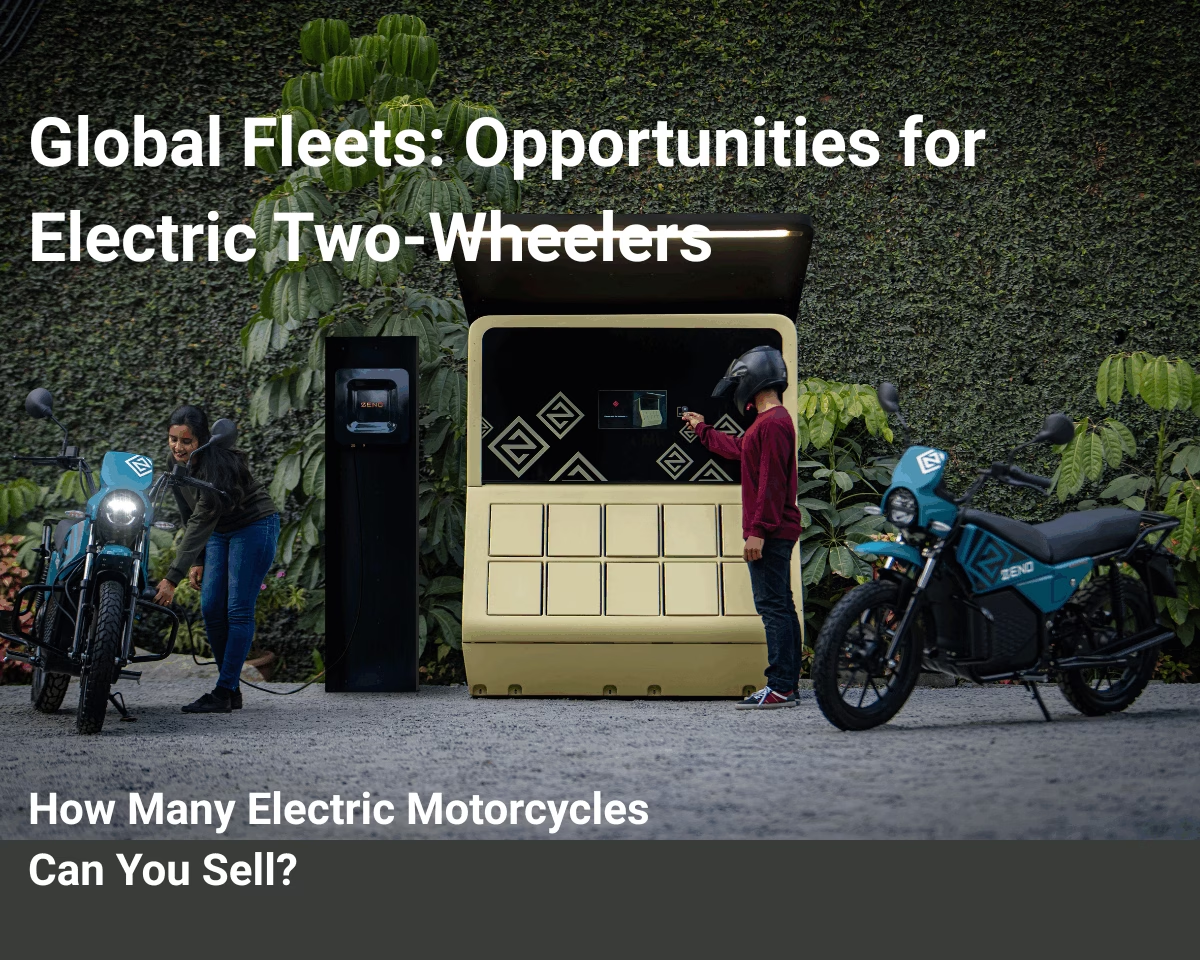

That is the most common and significant question that investors and startups ask each other when pitch decks are discussed. The common fallacy is to take the overall sales in any market, call it the Total Addressable Market (TAM), and assume that their vehicle startup would be able to take X% of the market.
That never happens. Overall, personal mobility has a slow transition. Even the most successful markets outside China, geographies like India and Vietnam, have managed to reach just about 7% penetration levels after years of starting out on the electric journey.
There are certain sections of electric mobility that would remain stubborn to change for a long time, limited as we are, with electric technology. Lifestyle motorcycling is one such area, and this study is not about that.
The right question to ask then should be, “What sections of mobility should be the easiest to convert to electric?”
Defining the TWAR and FAR Ratios
We did not want this report to be based on anecdotal evidence. Even though it may be evident that early trends in most of the geographies under discussion point to how mass electric mobility would evolve in the future, there is a reason why it would be. So we defined two metrics – Two-Wheeler Affordability Ratio (TWAR) and the Fuel Affordability Ratio (FAR) that peg the prices of popular two-wheelers and pump prices of fuel, respectively, to the GDP Per Capita of the country, on a PPP basis. The benchmarks are set by ICE two-wheelers, and E2Ws have to measure against them. A specific country’s TWAR and FAR scores are a good indicator of the mass acceptance of electric mobility. But they remain broad brushstrokes. Local factors often overshadow. And within mass-mobility, not everyone would be an easy convert to electric. Only some would be.
Delivery fleets are an obvious answer. Over the last five years, especially during and after COVID-19, delivery became an integral part of our lives. From e-commerce to groceries, food, and quick commerce, more people are relying on delivery than ever before. We are even sending parcels to each other within the city.
Then there are motorcycle taxis, an almost alien concept for the developed world, but the lifeline for almost every sub-Saharan African country and even highly congested mega-cities in India. That alone is millions of riders, almost all riding ICE motorcycles today.
Pushing the ICE to EV conversion in Africa
But should they be riding ICE? A simple Total Cost of Ownership (TCO) calculation shows that ICE vehicles are expensive. Even more so in oil-importing, fragile economies, with volatile currencies. A Boda Boda (motorcycle taxi) rider in Africa takes home a much smaller sum than what he spends on fuel. That’s unfair on the rider, who at times rides more than 200 km every day in harsh conditions, to earn his livelihood.
Electric mobility has the power to change that, and do much more. E2Ws really start making sense when the vehicle transcends from being just a mode of transport to becoming a mode of employment and a lifeline for society. We would see that happening in Kenya, Rwanda, Nigeria, Benin, Togo, the Ivory Coast, Tanzania, Uganda, Ethiopia, Ghana, and many more countries in the coming years.
Sure, there are challenges – no motorcycle has a practical 200 km range. Not with a 200 kg payload, anyway. Even if they did, it is unlikely that the rider has access to stable electricity when he goes home.
Battery swapping could be a solution, and that is what early participants in Africa are doing. So a rugged motorcycle that allows (at least) triple riding, combined with swappable battery packs, a swapping network with special connection to the grid, supported by solar charging and power backups, is how the ecosystem is expected to shape up in Africa in the future. We discuss Africa
Employment Generation in India
Then, in India, which grapples with double-digit unemployment in smaller cities and villages, food delivery and quick commerce are driven by a different form factor – the slow-speed moped. In the early days, they came from China, but Indian companies have since improved and indigenised them. The slow-speed moped (sub 25 kph) makes so much sense on multiple fronts. For fleets, it is cheaper to deploy, easier to maintain, consumes less energy, and requires no registration. Payload is less, rider plus 20 kg, but that’s all that is needed to deliver food and small lot groceries in congested cities.
For the riders, it makes a lot of sense – they are subprime, have very minimal identity documents, often have no driving license, and come from an underprivileged background, all of which means they cannot buy a vehicle or pay for a license. The good news is that regulations allow slow-speed mopeds to be operated without a license or helmet. It is the shortest, surest way of gaining employment without any investment.
For now, the Indian delivery market is booming with two of the major players already traded on the Indian bourses and likely another two headed for an IPO. Estimates in large cities indicate that delivery riders earn nearly the same as entry-level software engineers. Yet challenges remain, and we discuss that on Slide # 57.
Going Green in South America
Then there are the South American markets. Not all are an ideal fit based on their TWAR and FAR scores. But the delivery market is a fair game. A large, densely populated city like São Paulo has more than 400,000 delivery riders, almost all on 160cc-250cc motorcycles. That’s a lot of noise and pollutants, a strong local factor for a strong move to electric mobility.
Methodology
In this study, we evaluate 74 geographies, the term mostly meaning cities, but at times encompassing twin cities (Yaounde+Douala), or entire regions (like Keihanshin in Japan), and even countries (DRC, India, Nigeria, etc.). We also profile 32 leading delivery platforms globally, and 31 manufacturers who are responsible for the vehicles.
The geographies, combined, represent 31.5 million delivery riders, a number that is forecasted to swell to 44.7 million in five years. Not everything and everyone would turn electric, so our individual-geographies-up forecast came up with a five-year cumulative number of 19 million commercial riders switching to electric. That’s the number of electric vehicles this sector would consume in the next five years. Supporting that would require more than 57 million packs to be deployed.
Mind you, that is just what the commercial use E2W market needs in the selected 74 geographies, not the comprehensive sum total of all E2W motorcycles that we would need globally, commercial and personal.
This brings me to two pertinent questions that I would like to leave you with as you start consuming this report.
As an industry, are you planning to build enough capacity to target this expansion?
As an investor, are you investing enough?
Check the syndicated study.