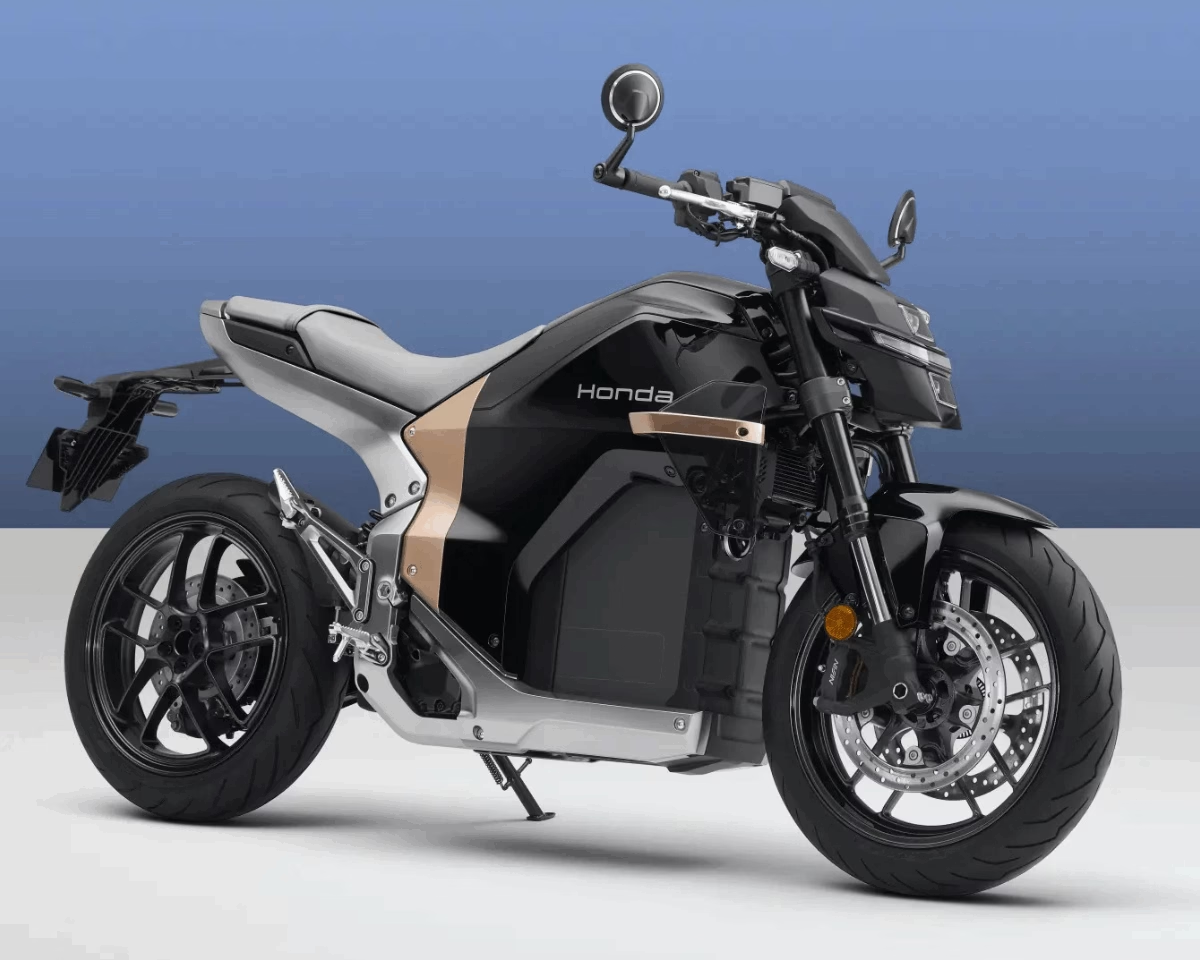
Last week, Honda released much-awaited details about its upcoming mid-size (Honda likes to call it full-size) electric motorcycle, the WN7. We came late to the party, as every media outlet had already reported on what the WN7 packs. However, there are some interesting elements to deep-dive into.
This is an important motorcycle for Honda, the company’s first fixed battery electric two-wheeler in modern times. Considering the global market leader aspires to be a leader in electric mobility as well, the WN7 should be a sort of halo product at the top of the range.
The WN7 was first unveiled at EICMA 2024 as the Honda EV Fun concept.
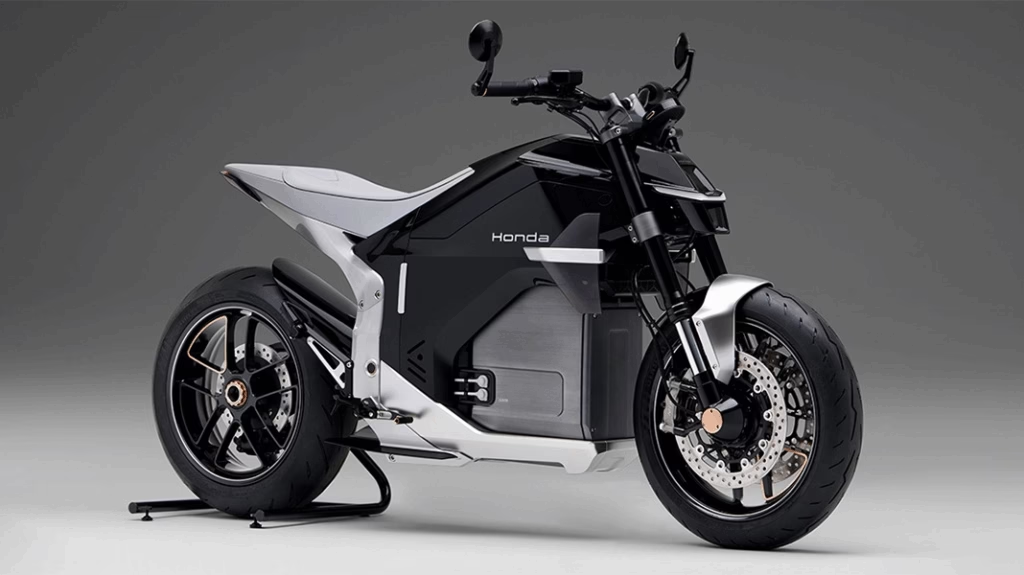
The production motorcycle, WN7, has turned out to true to the concept, though there are differences that we will come to later.
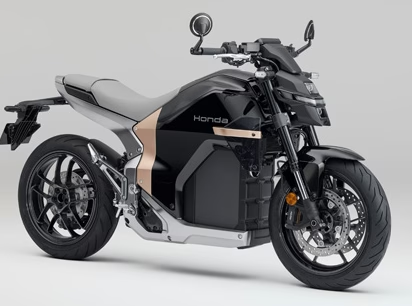
What’s in the name?
Let’s get the name out of the way first. There is a certain mechanical(!) quirkiness in the way Honda has been naming its electric motorcycles. A few months back, it launched an electric motorcycle (if a 16″/14″ vehicle can be called that) in China and named it WH8000D, where “WH” stood for Wuyang-Honda, “8000” represented the power output, and “D” represented the vehicle category code.

Similarly, in the case of the WN7, the W means Wind, from “Be The Wind”, the name of the development concept that eventually became the motorcycle. “N” stands for Naked, and “7” indicates the power output class.
How do the numbers look?
Honda seems to have focused on the usability of the WN7.
That’s polite speak for when the numbers are not really crushing it.
There are two variants, one with 11 kW constant power (A1 license) and the other is a higher-powered variant with 18 kW power (A2 license class). The good thing is that the higher-powered variant makes 50 kW (67 PS) at peak and has 100 Nm at the shaft. These are fairly competent numbers, and with a liquid-cooled motor, it means that the Honda can likely stay at highway cruising speeds for usable long times.
A critical missing information is the pack voltage. A 50 kW peak should ideally be a high voltage territory but we don’t know till Honda tells us so. Without the pack voltage, we cannot comment on the C-rating or the type of cells the pack is likely using.
We also do not know how much the wheel torque is. If the liquid-cooled motor has an inbuilt gearbox with a chain-drive final reduction, this can be multiplied 7-8 times at the rear wheel, making this a very entertaining motorcycle with likely more than 700 Nm at the wheel.
Without a primary reduction, we could still get 350-400 Nm at the wheel, not too bad, but not earth-moving either.
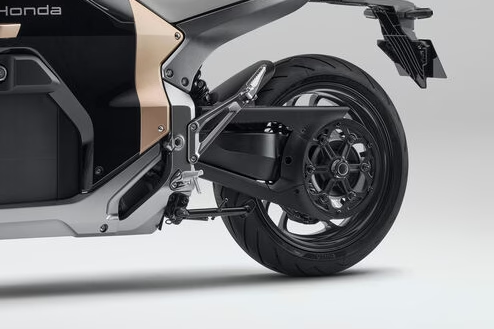
There are still a few ‘estimate’ numbers in the WN7, and Honda will only reveal the detailed specs at EICMA 2025.

But Honda mentioned 600cc/1000cc?
Yes, they did. What Honda has been saying is that the power output is at 600 cc levels. At 67 PS peak that the WN7 produces, this is Honda taking creative liberties. Their own 600-650 cc lineup is closer to 100 PS than to 67 PS. That’s because in the European market, Honda’s 650cc street/sports motorcycles are all four-cylinder with much higher power than the WN7.
Unless, by 650cc, Honda is pointing to all the other 650cc class motorcycles on the road, and then it has a point. The Kawasaki Z650 is at 50 kW, and the Yamaha MT-07 is at 54 kW, so not too far off from the WN7.
At 100 Nm, the torque is considered equivalent to that of a 1000 cc motorcycle. That is closer to home, as Honda’s own CB 1000 Hornet in the UK market produces 104 Nm. However, the Hornet’s 104 Nm gets multiplied at three stages before it hits the rear wheel.
Conversely, the WN7 starts making 100 Nm at 1 rpm while the Honda Hornet 1000 would hit peak torque at 9000 rpm.
The Top Speed is more than 110 kph
We are hoping that’s just a typo and they wanted to write 110 mph. There are a couple more typos in the Honda UK spec sheet, so we hope this is also one. A top speed of 110 kph works for a 125 cc equivalent motorcycle, not something that proclaims 600 cc equivalent performance.
The optimist in us also would like to believe that the ‘more than 110 kph’ is Honda’s placeholder that the motorcycle is motorway capable. In the UK, that comes to just about 70 mph, making the WN7 ‘technically’ motorway capable. But 110 kph, if it stays that way, is underwhelming, whatever way you may look at it. It’s even lower than the India-made Ultraviolette F77, which has a claimed 155 kph top whack.
Now, Honda uses the words “More than 110 kph” in its literature, so we are hoping that it’s likely 60 kph more than 110 kph. But then, this is Honda. They have been messing around with their electric offerings, getting 99 things right but making catastrophic mistakes on one big ‘un. For example, on the scooter front, in India, its largest market, Honda has managed to court disaster with its atrocious pricing.
The Battery, Charging, and Range
For now, we don’t know the battery size, cell format, chemistry, or thermal management in the battery. We know that this is a fixed battery motorcycle. Honda is putting the range estimate at 130 km, which should be in the acceptable territory, considering that there is a CCS 2 compatible charger at the top of what would be a gasoline tank in an ICE motorcycle. The CCS 2 compatibility ensures a 20-80% charge in 30 minutes, provided you are connected to a suitable fast charger. The bike can also be charged from a 6 kVA wall box charger (Type 2) that puts the 0-100% charging time at around three hours.
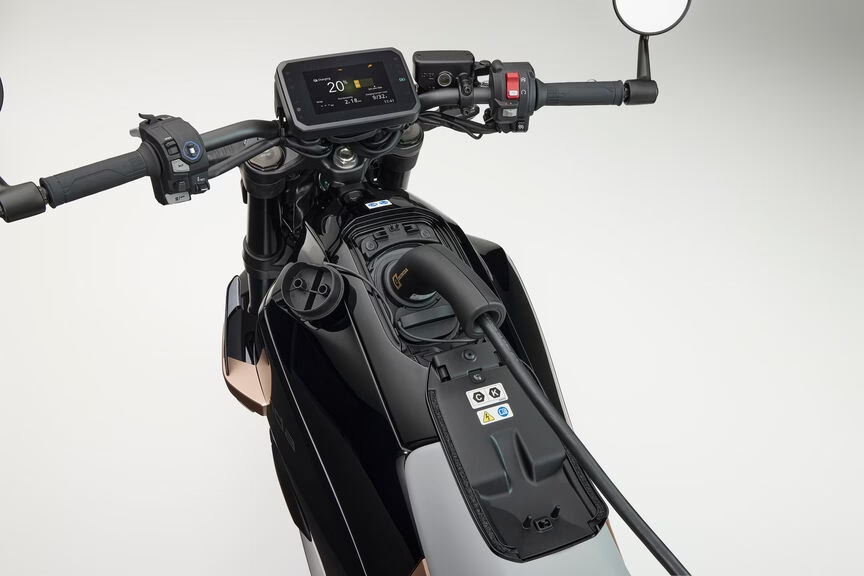
This is pretty acceptable stuff on the charging front. We do not know the size of the battery, though the charging times and range indicate a 7 kWh – 10 kWh pack size. Motorrad puts the estimate at about 10 kWh, which should not be too far off.
Other Attributes?
The WN7 weighs a hefty 217 kg, which means Honda has not used any exotic materials or innovative frame geometries. A weight of 217 kg is heavy, irrespective of whoever you benchmark it against. The Zero S with its 15 kW motor should be a close competitor, and it weighs 223 kg. However, the S has a 14.4 kWh pack, about 4 kWh heavier than what the WN7 is likely carrying. Also, remember that the Zero S is a dated product and should not be Honda’s benchmark in the first place.
The other competitor, the much less powerful Ultraviolette F77, tips the scales at 207 kg. With its 10.3 kWh battery, the Ultraviolette has likely a comparable-sized pack to the WN7. The motor weight would change as the F 77 Recon has a motor that has a peak of about 60% of the WN7’s peak. In the past, we have been critical of the Ultraviolette’s excess weight, and we share the same opinion on the Honda WN7.
In fact, if we put the WN7 against the motorcycles we recently compared in a study, it comes up worst on the weight aspect.
 InsightEV – Global Electric Mobility
Connectivity
The WN7 comes with a 5 ” TFT with the Honda RoadSync operating system. That seems to be standard in the range, as we don’t see a with/without option.

Price and Start of Sale
The UK and Europe seem to be the only markets where Honda is introducing the WN7 for now. There is no US plan for now, and the high pricing may mean just a token launch for India and ASEAN at some later date.
The WN7 goes on sale in early 2026 and has a starting price of GBP 12,999/EUR 14,780. That is likely the price of the 11 kW variant. Again, the rest of the details are sketchy, and we have to wait till EICMA.
Apples-to-apples, the Ultraviolette F77 Recon sells at GBP 9,399 and the Zero S sells at more than GBP 12,000.
Importantly, a Kawasaki Z 650 sells at GBP 7,139 in the UK, so we still don’t see the business case.

WN7: A missed chance?
Honda has made ambitious announcements for going electric. However, it wants to remain “Honda” in playing a game where the only participants are startups free from rules or the Chinese…again, free from rules. The WN7’s pricing is a lost cause, and Honda definitely wants to preserve its model-level EBITDA margins. We have seen this happening with the Activa e: in India, and sales have failed to take off.
What has changed from the EV Fun concept?
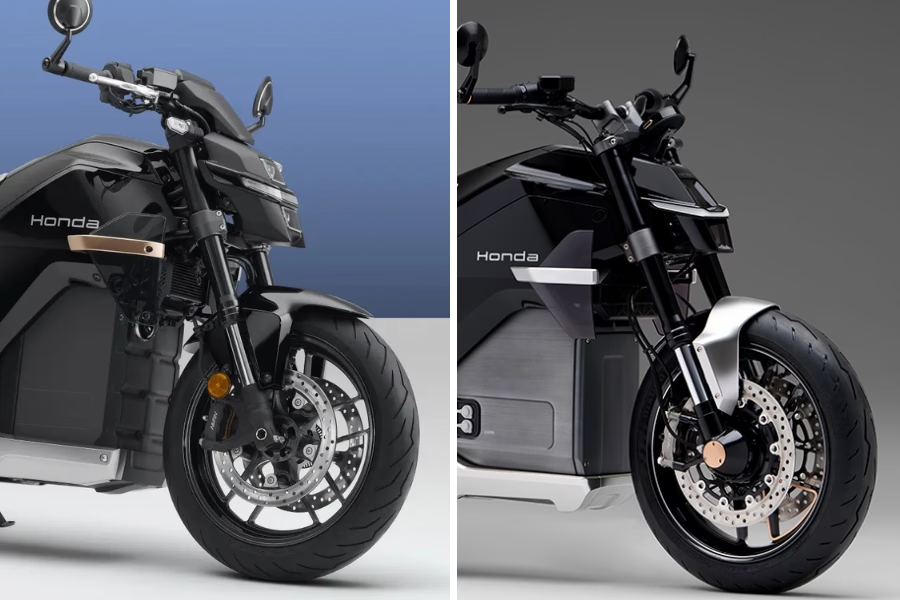
- At first glance, there are obvious styling elements that have changed. The headlamps in the production model are more pronounced, and there is a semi-cowl on top of the lamp to protect the display.
- The CMF was richer in the concept, and while it’s not bad in the WN7, it does feel more mainstream than exotic.
- Some design elements, like the HV connectors at the bottom of the battery, have disappeared in the production motorcycle.
- The much-discussed conical outgrowth covering the front lug nut has disappeared in the WN7.