
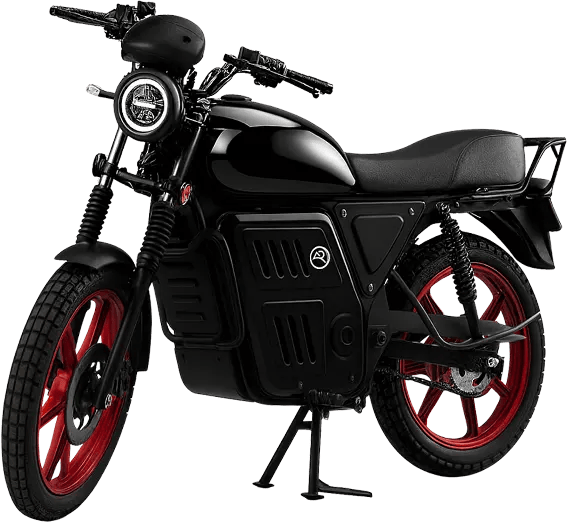

Kenya’s ARC Ride has closed a mixed equity-and-debt round to add 5,000 motorcycles and push into four new markets. This is a significant raise by any count and makes ARC Ride a significant player in a market where Spiro overshadows everyone in access to capital.
The News
ARC Ride, the Nairobi-based electric two- and three-wheeler operator founded in 2019 by Joseph Hurst-Croft and Joanna Cheong, has closed a USD 33.3 million financing round. Novastar Ventures and Norrsken22 led it, with the International Finance Corporation, British International Investment and Proparco joining as co-investors. Existing shareholders Musashi Seimitsu, the Japanese driveline supplier, and Talanton, an Africa-focused impact investor, put in further capital.
Proparco (which contributed USD 1.5 million to the round) disclosed that the round splits roughly into USD 23 million of Series A equity and USD 10 million of debt, the latter drawn from BII’s Kinetic programme and from Mirova. This is the second time ARC Ride has raised debt against its battery fleet. In September 2025, Mirova’s Gigaton Fund committed up to USD 10m in debt — its first e-mobility investment anywhere — to fund more than 600 swap cabinets and 25,000 battery packs across Kenya.
The new raise is earmarked for deeper density in Kenya, an additional 5,000 electric motorcycles, automated swapping, smart charging, solar integration, and entry into Ghana, South Africa, Tanzania, and Uganda.
An Energy Business, Financed Like One
When we wrote BodaBodas Part Deux in 2024, we made an argument that was unpopular at the time: this (nearly everyone in Africa) is an energy business, not a motorcycle business. Energy businesses are commodity businesses, decided by volume, utilisation and execution, capital efficiency, rather than by product innovation. They have almost no barriers to entry beyond the relationships an operator builds with financiers and with riders. The moat is shallow.
If you are running a commodity energy business, funding it with venture equity is the most expensive possible way to buy an asset that depreciates predictably and generates a measurable, meterable revenue stream. Battery packs and swap cabinets are exactly the sort of collateral that debt exists for.
Every dollar of battery CAPEX financed with equity is a dollar of permanent dilution spent on a metal box that will be worth 30 percent of its cost in six years.
Importantly, a third of ARC Ride’s round is debt, secured against the asset it is buying.
Going back to the October 2025 debt facility on its own, if the 25,000 packs sit in the 1.4-2.0 kWh band that ARC Ride has used to date, the company put roughly 35-50 MWh of stationary and mobile storage into Nairobi on borrowed money. The equity holders did not pay for it. Very few operators on the continent have managed that.
What Actually Makes ARC Ride Different
To start with, the battery-to-vehicle ratio looks generous if we just went by the latest announcement. ARC Ride talks about 25,000 packs against 5000 motorcycles. That is a 2.5X float, where the norm is to be within 1.5-1.8X. The good thing is that this high pack density would likely offer “always ready” packs at the swapping stations.
The bad thing is that it’s not the most optimised deployment of capital.
Musashi Seimitsu, a Japanese Tier-1 gear and driveline specialist, has been on this cap table since 2021 and has worked directly on ARC Ride’s powertrain unit. They are also on the cap table of BNC Motors, an India-based OEM from which ARC Ride has sourced in the past.
However, ARC Ride is not the only African manufacturer that Musashi is backing. They are also investors in Dodai, the Addis Ababa-based battery swapper.
South Africa is a surprise
One of the markets that ARC Ride has included in its expansion, post this funding round, is South Africa. It is a surprising choice. It’s not a boda-boda market. It’s more of a delivery-led market, but with high homologation and high electricity costs. That makes it less attractive than the Central African belt of countries.
Open Architecture and Interoperable
ARC Ride describes its packs as open-architecture and interoperable. The investors look at it as a position of strength.
Ngetha Waithaka, partner at Norrsken22, noted:
“We back founders building category-defining platforms, and ARC Ride is exactly that. Jo and the team have engineered a battery-as-a-service model whose technology, data and network effects give it the potential to become the open standard the entire ecosystem plugs into. The unit economics are compelling, and the product is winning with riders. We are thrilled to partner with them as they scale.”
However, open architecture is now a hotly contested ground, and no longer a moat. Only last month, India-based battery swapping major, SUN Mobility, launched an open-architecture network in Kenya in August with Vivo Energy, with more than ten vehicle partners and a five-year plan for 2,500 stations.
While ARC Ride has an open protocol, we have not seen any major OEMs, except Yadea, deploy motorcycles on the network.
Our Perspective
The USD 33 million raise is significant but not substantial. It spreads thin when the ambition is to enter four new markets. We expect a majority allocation for Kenya and the other markets to be a light-touch entry rather than a serious play.
On the cap table, IFC, BII, Proparco, Mirova, and a substantial part of Norrsken22’s mandate are development or impact capital. That money is patient and cheap, which is exactly right for infrastructure.
Still, the direction of travel is correct. Our forecast in the Africa Motorcycle Taxi and Delivery Market report is that the continent can absorb millions of electric motorcycles over the coming five years. The winners will be the operators who treat the boda as a mode of employment rather than a unit sale.